
About this story
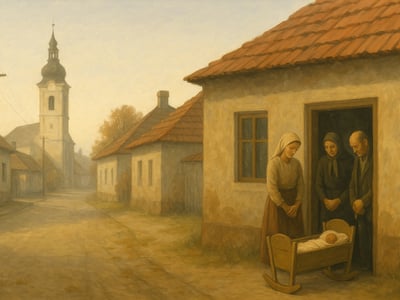
On 9 October 1920 Viliam Záborský was born in Vráble, in Czechoslovakia, a state founded on 28 October 1918. The birth itself was private. Its later meaning sits in Slovak cultural life: he worked as a stage actor, a pedagogue, and a reciter, with a career tied to professional theatre in Bratislava. The date is a fixed point for a life that helped carry performance, teaching, and the spoken word.
Viliam Záborský, born in Vráble in 1920, later worked in Slovak theatre.
On 9 October 1920, Viliam Záborský was born in Vráble, in what was then Czechoslovakia, a state only two years old. The event itself was simple and private, as every birth is. Its historical meaning comes later, because the child born that day would go on to become known in Slovak cultural life as an actor, teacher, and reciter, with a career connected to the institutions of professional theatre in Slovakia.
A birth in a two-year-old state
That makes his birth one of those dates that matters less for immediate drama than for what it helps place in time. Záborský belongs to a generation whose lives unfolded alongside the development of modern Slovak cultural institutions during the 20th century. To note his birth is to mark the beginning of a biography that would later intersect with the growth of professional stage work, performance training, and public recitation in Slovak society.
Vráble, the town where he was born, had become part of Czechoslovakia after the creation of the state in 1918. For many people born in the early 1920s, this meant growing up in a political and cultural environment that was still being defined. In Slovakia, questions of language, education, and public culture were closely tied to institution-building. Theatre was part of that process. It was not only entertainment but also a place where language was heard, roles were modeled, and cultural ambitions became visible in public form.
Within that broader setting, Záborský later entered Slovak professional theatre. The available factual outline is modest but clear: he worked as a stage actor during the 20th century, he was active as a pedagogue, and he was also known as a reciter. Those three roles are worth pausing over, because together they describe a kind of cultural worker whose importance cannot be measured only by a list of stage appearances.
Actor, teacher, and reciter
The actor appears before an audience and gives shape to a script through voice, gesture, rhythm, and presence. The pedagogue works differently, passing on technique, discipline, and habits of interpretation to others. The reciter occupies yet another place in cultural life, often bringing literary language into public performance through the spoken word alone. In a smaller national culture, especially one building and strengthening its institutions over time, these functions can overlap in meaningful ways. A performer may also be a teacher; a teacher may help standardize styles of speech and delivery; a reciter may help connect literature with audiences beyond the formal stage.
Záborský’s career became associated with major Slovak theatre activity centered in Bratislava. That association matters because Bratislava was a key institutional center for professional theatre in Slovakia. Careers linked to the city often moved through environments where repertory, training, and artistic standards were being shaped in practical, daily work rather than in abstract theory. Rehearsals, productions, classroom instruction, and public recitals all formed part of the same cultural ecosystem.
This is also why a birth date like 9 October 1920 can be useful to historians and cultural institutions. It provides a fixed point from which the arc of a life can be organized. Archives, theatre histories, biographical dictionaries, and commemorations often depend on such dates. Without them, the history of performance becomes harder to document, and performance is already an art form that can vanish quickly once the curtain falls. A printed book survives on the shelf; a stage performance survives only through records, memories, reviews, photographs, and the later work of people who were trained within the same tradition.
A career tied to Bratislava
In that sense, Záborský’s biography reflects more than individual achievement. It also shows how theatre history is often carried by people whose work crossed several domains at once. The growth of Slovak professional theatre in the 20th century did not depend only on playwrights, directors, or famous premieres. It also depended on actors who sustained repertories, on teachers who formed younger performers, and on reciters who kept literary speech audible in public culture.
A figure like Záborský fits that pattern well. Even a concise factual record suggests continuity rather than spectacle: work on stage, work in teaching, work in recitation, and connection to Bratislava’s theatre world. That continuity is historically valuable. It shows how cultural life is built through repetition, training, and institutional commitment over many years.
Why it still matters
Remembering the birth of Viliam Záborský still matters because national theatre history is not made only of landmark openings or celebrated texts. It is also made of individual careers that help explain how performance traditions are maintained and transmitted. When historians, theatres, and cultural institutions mark a birth date like this one, they are preserving the human framework behind larger institutions.
Záborský’s later work as actor, pedagogue, and reciter points to a broader truth about theatre: each generation depends on the previous one not only for scripts and buildings, but for methods of speaking, interpreting, and inhabiting a role. Teaching and performance are closely linked. What one generation learns in rehearsal rooms and on stage can become the foundation of the next.
His life also reflects the cultural structures of Czechoslovakia and, later, Slovakia. A stage career did not develop in isolation. It was shaped by schools, theatres, cities, and public institutions that gave performers places to train and work. Looking back to his birth in Vráble in 1920 is therefore a way of tracing how one person’s life became part of a larger cultural network.
The date itself is quiet, but its significance endures in the documentation of Slovak theatre history. It marks the beginning of a career tied to performance, teaching, and the spoken word—three enduring parts of how a theatrical culture sustains itself over time.
Timeline
- Czechoslovakia is established
- Viliam Záborský is born in Vráble
- Birth falls in a state only two years old
What you uncovered
A Life on the Slovak Stage
You didn't just place a name on a timeline; you connected a birth date to the people who carry theatre forward through performance, teaching, and spoken interpretation.
Birth anniversaries like this one matter less because they mark a beginning than because they help trace how cultural traditions are sustained over time. Záborský's career points to a side of theatre history that is easy to miss: stages are shaped not only by playwrights and institutions, but also by performers who teach, recite, and pass on technique from one generation to the next. That makes biography a useful way to see how cultural systems endure.
Viliam Záborský was born in Vráble on 9 October 1920, when the town was part of the still-young state of Czechoslovakia.
FAQ
Who was Viliam Záborský?
Viliam Záborský was a Slovak stage actor, pedagogue, and reciter. He is associated with Slovak professional theatre in the 20th century.
When was Viliam Záborský born?
He was born on 9 October 1920.
Where was Viliam Záborský born?
He was born in Vráble. At that time, Vráble was part of Czechoslovakia.
Why is Viliam Záborský noted in Slovak theatre history?
His career became linked with major Slovak theatre activity, especially in Bratislava. He also contributed as a teacher and reciter, not only as an actor.