
About this story
On 14 October 2022, two days after a fatal shooting outside the Tepláreň bar on Zámocká Street in Bratislava, the March against Hatred carried mourners from the bar toward Námestie SNP. Two people had been killed on 12 October and another injured. President Zuzana Čaputová and mayor Matúš Vallo were among those who appeared in the city’s public response.
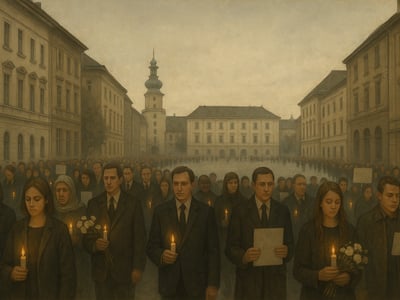
Commemorative march in Bratislava after the October 2022 shooting outside Tepláreň.
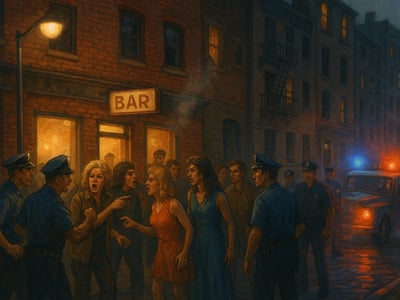
On 14 October 2022, two days after a fatal shooting outside the Tepláreň bar in Bratislava, a public vigil titled the March against Hatred brought mourners into the streets of the Slovak capital. The gathering followed the attack of 12 October, in which two people were killed and another person was injured on Zámocká Street. In the short span between the shooting and the vigil, grief, shock, and public attention were channeled into a visible act of commemoration.
A bar, a street, a route
The setting mattered. Tepláreň was not simply a point on a city map but a place linked in public discussion to LGBTQ life in Bratislava. That made the attack more than an isolated crime scene in the eyes of many participants and observers. Yet the vigil itself was framed not around spectacle or confrontation, but around mourning and opposition to hatred. In practical terms, that meant assembling people quickly, creating a route through the city, and giving public space to remembrance.
According to widely reported accounts of the events that week, participants gathered near the area of Tepláreň before moving toward Námestie SNP in central Bratislava. The route connected the site of the shooting with one of the city's best-known civic spaces. That movement from a specific street to a central square gave the event its public shape. It marked a passage from immediate aftermath to collective observance.
Mourning in public
Such vigils often serve several purposes at once, even when they remain solemn and restrained. They allow people to appear in person rather than respond only through statements or social media. They provide a way for those not directly connected to the victims to register grief and solidarity. They also create a common setting in which officials, organizers, and residents can stand side by side, even if they may not agree on every political conclusion to draw from the violence.
In Bratislava, public figures were part of that shared setting. President Zuzana Čaputová attended commemorative events connected with the shooting in October 2022, and Bratislava mayor Matúš Vallo appeared at the 14 October gathering at Námestie SNP. Their presence gave the vigil an institutional dimension without changing its basic character as a public memorial. When elected leaders attend such events, they do more than make a statement. They help signal that mourning in response to violence is not only private but civic.
Námestie SNP, two days later
That civic character was reinforced by the choice of Námestie SNP as a destination. The square has long been used for assemblies, commemorations, and demonstrations in Bratislava. Bringing the march there placed the vigil within a familiar urban language: when people in the city need to gather for grief, protest, or public reflection, central squares become stages for shared memory. The march therefore connected a recent act of violence to older patterns of public assembly.
The speed with which the vigil was organized is also part of the story. Events held so soon after an attack can face obvious difficulties. Organizers must communicate clearly, coordinate movement through the city, and do so under the pressure of national media attention and heightened security concerns. Participants, for their part, must decide whether to enter a public crowd at a moment when emotions are raw and facts are still being discussed. The March against Hatred took place despite those conditions, which helps explain why it drew notice beyond Bratislava itself.
Remembrance with a narrow purpose
At the center of the vigil, however, were the victims and the act of remembrance. Public commemorations after violence can easily become overwhelmed by argument over motive, responsibility, or political meaning. In this case, those broader debates were present in Slovakia, as they often are after an attack linked in public understanding to a minority community. But the event on 14 October kept a clear ceremonial purpose: to honor those who had been killed, acknowledge the person who had been injured, and offer a collective answer to fear through presence.
That answer was necessarily limited. A march cannot undo a shooting, and a vigil cannot resolve the deeper disputes that follow targeted violence. Yet public assemblies are not meant to solve everything at once. Their significance often lies in showing whether a city will leave grief scattered among individuals or make room for it in common view. In Bratislava, the march from the area near Tepláreň to Námestie SNP did the latter.
Why it still matters
The March against Hatred remains notable because it shows how a city responds when violence at a particular venue becomes a wider public concern. The attack happened at a specific place and affected identifiable victims, but the vigil turned that immediate loss into a broader act of civic commemoration. It demonstrated how public mourning can move from the margins of a neighborhood to the symbolic center of a capital.
It also illustrates the role of institutions in moments of public grief. The attendance of the president and the mayor showed how national and municipal offices can participate in remembrance without displacing civic organizers and ordinary attendees. In many democracies, that balance matters: official recognition can lend weight to mourning, while public assembly keeps the response rooted in citizens rather than ceremony alone.
The event is still relevant as a recent example of how questions around hate, safety, and belonging enter national discussion through physical gathering in shared urban space. City squares, memorial routes, and vigils may look temporary, but they often become part of how societies remember turning points. In Bratislava in October 2022, the March against Hatred became one of those moments: a collective pause after a deadly attack, and a public effort to define the city's response through remembrance rather than silence.
Timeline
- Shooting outside Tepláreň on Zámocká Street
- President Čaputová visits Tepláreň
- March against Hatred reaches Námestie SNP
What you uncovered
From Venue to Public Square
You didn't just… complete a puzzle; you traced how a public gathering turned grief after the Bratislava shooting into a shared act of remembrance in the city itself.
Public vigils do more than mark loss: they also shift where a society chooses to speak about violence. In this case, movement from a specific venue to a central square helped place private shock into a visible civic setting, where organizers, local institutions, and national figures could participate in the same act of commemoration. That kind of public assembly can shape national discussion not by resolving disagreement, but by making mourning and opposition to hatred part of shared civic space.
Participants in the 14 October 2022 March against Hatred moved from the area near Tepláreň to Námestie SNP in central Bratislava.
FAQ
What happened in Bratislava on 14 October 2022?
A public vigil and march called March against Hatred took place in Bratislava on 14 October 2022. Participants gathered to commemorate the victims of the shooting outside Tepláreň two days earlier.
What happened outside Tepláreň on 12 October 2022?
On 12 October 2022, a shooting outside Tepláreň on Zámocká Street in Bratislava killed two people and injured one person. The attack happened two days before the public vigil.
Where did the March against Hatred event go?
Participants moved from the area near Tepláreň to Námestie SNP in central Bratislava. The march ended at the city square, where commemorative gathering continued.
Which public figures attended the Bratislava commemoration?
President Zuzana Čaputová attended public commemorative events connected with the shooting in Bratislava. Bratislava mayor Matúš Vallo also appeared at the gathering at Námestie SNP.