
About this story
On 13 November 1918, the Czechoslovak National Committee in Prague adopted a provisional constitution, Act No. 37/1918, for a state proclaimed on 28 October. The act let a National Assembly legislate and elect the president and the government before nationwide elections. The assembly sat the next day and chose Tomáš Garrigue Masaryk as president. Slovak support for a common state had been expressed in the Martin Declaration of 30 October. The Constitutional Charter of 29 February 1920 replaced the interim act.
Act No. 37/1918 defined legislative and executive institutions for the new Czechoslovak state.
On 13 November 1918, the Czechoslovak National Committee in Prague adopted a provisional constitution for a state proclaimed little more than two weeks earlier. Act No. 37/1918 provided for a 256-member National Assembly and defined how the president and government would be chosen. It was an interim arrangement, designed to give the new Czechoslovak state functioning central institutions before nationwide elections and a permanent constitutional settlement.
A state proclaimed, and offices still to fill
The immediate background was the dissolution of Austria-Hungary. On 28 October, the National Committee had issued Act No. 11/1918, establishing the independent Czechoslovak state while provisionally maintaining existing laws. That combination addressed an urgent practical need: independence did not remove the need for courts, offices and public administration to work under recognizable rules. Political authority was changing, but everyday legal business could not simply stop.
Continuing existing law, however, did not fully answer a different question: who would now make new laws and choose the state's executive leaders? The National Committee had acted at the moment of independence. A constitutional framework was needed to turn that transitional authority into institutions with defined responsibilities. Karel Kramář, the committee's chairman, was among the central figures in this process.
An assembly before nationwide elections
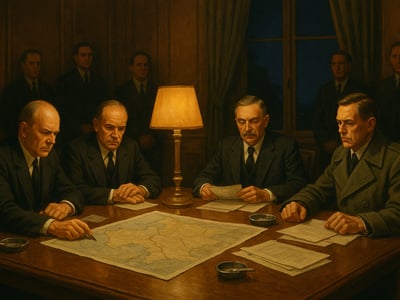
The difficulty was one of both timing and representation. Nationwide elections had not yet been held, but decisions about governing could not wait for an elected parliament. The provisional constitution addressed this by providing for the National Committee's expansion into a National Assembly of 256 members. The assembly would exercise legislative authority. Its origins therefore lay in the transitional political arrangements of independence, rather than in a fresh nationwide vote.
This distinction is important for understanding what the act accomplished. It established a working constitutional structure without claiming to be the final settlement. The provisional framework answered immediate questions about the exercise of power while leaving the longer-term constitutional order to be developed. Its temporary character was part of its purpose: institutions had to begin operating before all the conditions for a permanent arrangement were in place.
President and government the next day
The assembly's responsibilities extended beyond legislation. The act assigned it the election of both the president and the government. This placed the choice of the state's executive leadership in the hands of the representative body established by the provisional constitution. Rather than leaving those appointments to separate, competing sources of authority, the framework supplied a common institutional procedure.
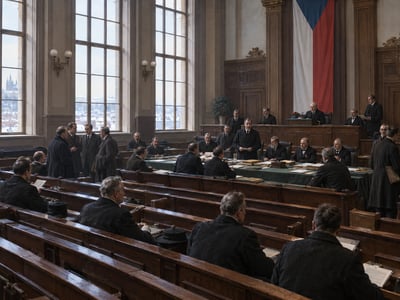
The practical consequence followed quickly. On 14 November, the National Assembly held its first sitting in Prague, elected Tomáš Garrigue Masaryk president and elected a government headed by Kramář. These were distinct steps on consecutive days: the National Committee adopted the constitutional framework on 13 November; the assembly used that framework to choose the president and government on 14 November.
Slovakia in the new state, and the 1920 charter
The new state's inclusion of Slovakia gave this institutional work a wider territorial dimension. Slovak representatives had expressed support for a common state through the Martin Declaration on 30 October. Yet establishing Czechoslovak administrative authority in Slovakia remained an ongoing process during late 1918 and early 1919. A constitutional act adopted in Prague did not, by itself, settle borders or ensure that every locality was already administered by the new state.
Nor should the interim institutions be understood as evidence of universal agreement among the population. Czech, Slovak, Hungarian and minority perspectives differed, with differences within those groups as well. The constitution defined the new state's central governing arrangements; it did not resolve every question of political representation, national affiliation or territorial authority.
Why it still matters
The provisional constitution illustrates a recurring problem in state formation: essential institutions may have to operate before a permanent constitutional settlement is ready. Its importance lies in the specific allocation of powers. A legislature was constituted, and responsibility for choosing the president and government was assigned to it. Those provisions made the exercise of central authority more clearly defined.
The arrangement also offers a concrete starting point for examining parliamentary government. Giving the assembly the power to elect executive leaders connected their selection to a collective political body. Understanding that procedure helps distinguish the creation of an office from the question of who has authority to fill it.
At the same time, the experience of Slovakia shows why constitutional documents must be read alongside administrative history. Legal provisions describe institutions and their claimed jurisdiction; their implementation depends on officials and the establishment of effective authority. These were connected developments, but they did not occur everywhere at the same pace.
The provisional framework was eventually replaced by the Constitutional Charter adopted on 29 February 1920. Its role had been transitional but concrete: it supplied the institutional basis on which Czechoslovakia's first National Assembly, president and government began their work.
Timeline
- Independence Proclaimed
- Martin Declaration
- Provisional Constitution Adopted
- First National Assembly Sitting
- Constitutional Charter Adopted
What you uncovered
Between Proclamation and Practice
You didn't just… complete a puzzle; you revisited the moment when the new Czechoslovak state began defining its governing institutions.
Proclaiming a state, assigning constitutional powers, and establishing working administration are distinct processes, not a single event. In Slovakia, the provisional framework defined authority while the state's practical administration was still taking shape. The distinction matters: constitutional rules could establish who was entitled to govern without demonstrating effective control everywhere or universal acceptance of that authority.
The independence law of 28 October 1918 provisionally kept existing laws in force.
FAQ
What happened on 13 November 1918 in Czechoslovakia?
On 13 November 1918, the Czechoslovak National Committee in Prague adopted Act No. 37/1918 on the provisional constitution. It set up a temporary constitutional framework for the newly proclaimed Czechoslovak state.
What did Act No. 37/1918 establish?
Act No. 37/1918 expanded the National Committee into a 256-member National Assembly with legislative authority. It also provided that the National Assembly would elect the president and the government.
Who was involved in adopting the provisional constitution?
The provisional constitution was adopted by the Czechoslovak National Committee in Prague. Karel Kramář was its chairman.
How did 13 November 1918 differ from 14 November 1918?
13 November 1918 was the day the provisional constitution was adopted in Prague. On 14 November 1918, the National Assembly held its first sitting, elected Tomáš Garrigue Masaryk president, and chose a government headed by Karel Kramář.