
About this story
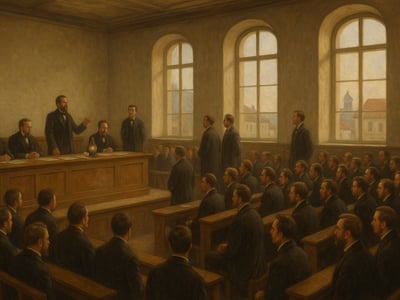
On 4 August 1863, Slovak patriots held the founding general assembly of Matica slovenská in Martin. The cultural institution became a central vehicle for Slovak language, education, and national life under Habsburg rule.
Matica slovenská was formally established at the 1863 assembly in Turčiansky Svätý Martin.
On 4 August 1863, a large gathering assembled in Turčiansky Svätý Martin, in the Kingdom of Hungary, for the founding general assembly of Matica slovenská. The town is today Martin in Slovakia, but at the time the event unfolded within the legal and political framework of the Habsburg monarchy’s Hungarian lands. What took place that day was not simply a public celebration. The meeting’s importance lay in something more exacting: the effort to turn long-standing cultural ambitions into a formally constituted institution with rules, officers, and a defined purpose.
A cultural institution for the Slovak language
Matica slovenská was created as a central Slovak cultural institution devoted to literature, scholarship, art, and the Slovak language. That formula may sound straightforward in retrospect, but in 1863 it required organization, negotiation, and public commitment. Cultural movements often generate declarations and enthusiasm; they become more durable only when they acquire structures that can publish, collect, correspond, fund projects, and outlast the moment that gave rise to them. The assembly in Turčiansky Svätý Martin was the point at which that transition was made visible.
The setting mattered. By the mid-19th century, Turčiansky Svätý Martin had become an important center of Slovak cultural life. Holding the assembly there gave the event a practical base and a symbolic focus. Delegates and supporters came to a place already associated with cultural work, and the town in turn became more firmly linked with the institutional history of Slovak public life. Contemporary reports and later commemorative accounts described the turnout as very large, though precise attendance figures are difficult to verify with confidence. Even without an exact number, the reports make clear that the gathering was understood by contemporaries as unusually substantial.
Martin as the assembly’s stage
That scale had meaning, but numbers alone did not found an institution. The real test of the day was whether broad support could be translated into a workable body. Organizers had to move from approval in principle to decisions that would give Matica slovenská legal and practical form. Such a step carried risk. A meeting can produce speeches and resolutions yet fail to establish procedures, leadership, or a mission capable of guiding future activity. The founders chose a different path. They tied cultural work to a permanent organization rather than leaving it at a symbolic declaration.
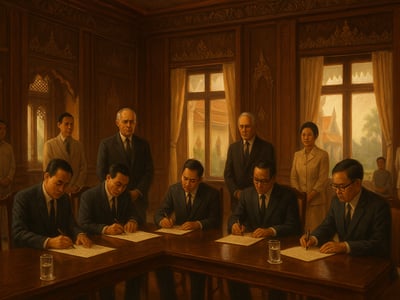
The assembly therefore proceeded to the essential work of institutional formation. Matica slovenská was formally established, and its first leadership was elected. Štefan Moyses became the first chairman, while Karol Kuzmány was elected first vice-chairman. These elections mattered not only because they placed well-known figures at the head of the institution, but because they demonstrated that the new body would operate through recognized offices and internal order. A cultural institution needed names, responsibilities, and legitimacy if it was to maintain continuity after the excitement of the founding day had passed.
Leadership and institutional founding
This emphasis on structure is one reason the event stands out in 19th-century history. Many national and cultural movements are remembered through petitions, protests, or moments of confrontation. The founding of Matica slovenská illustrates another path: building institutional capacity through statutes, assemblies, and elected leadership. It was a slower and more procedural form of action, but one with the potential to shape everyday cultural life. Instead of relying only on public sentiment, the founders attempted to create an organization that could support publishing, scholarship, and language work over time.
In practical terms, that mattered because language and culture are sustained through institutions as much as through ideas. A permanent body could sponsor publications, encourage scholarship, gather materials, support authors and intellectual exchange, and provide a center for work that might otherwise remain scattered. The founding assembly did not complete all that work in a single day, but it created the framework within which such work could proceed. By doing so, it gave the Slovak cultural movement a more durable base than occasional meetings or informal networks alone could provide.
Closure, restoration, and legacy
The moment also has to be understood with care. It belongs to a history of national and cultural organization in a multilingual kingdom, and later interpretations have sometimes invested it with meanings shaped by later politics. The documented facts are more precise and more useful: an approved institution was brought into formal existence; a leadership was elected; and a public gathering signaled support for the enterprise. Those facts are sufficient to explain why the assembly has remained a reference point in Slovak historical memory.
The later history of Matica slovenská also casts light backward on its beginning. The institution did not move through history without interruption. It was closed by Hungarian authorities in 1875 and restored in the 20th century. That later disruption helps explain why the founding assembly of 1863 is remembered so strongly. It marked the creation of an organized cultural center that could be suppressed, revived, and commemorated precisely because it had first been clearly constituted.
Why it still matters
The founding assembly of Matica slovenská still matters because it shows how cultural life is built through institutions, not only through ideas or public feeling. On 4 August 1863, support was converted into a durable framework: statutes, offices, leadership, and a mission. That process offers a clear example of how 19th-century cultural movements sought continuity.
It also matters because Matica slovenská became part of the infrastructure of Slovak publishing, scholarship, and language work. Institutions of this kind help standardize language, preserve texts, organize knowledge, and connect writers, clergy, scholars, and readers. Even when later political conditions changed, the model established in 1863 remained significant.
Finally, the assembly remains important as a historical case of organized public action within legal constraints. Rather than existing only as a symbolic gathering, it produced a functioning body. That combination of public support and formal structure is what gave the day its lasting place in history.
Seen in that light, the assembly in Turčiansky Svätý Martin was a foundational act of organization. Its legacy does not depend on uncertain crowd totals or retrospective mythmaking. It rests on something more concrete: a cultural movement chose to build an institution, named its leaders, and gave itself a structure meant to endure beyond the day of its founding.
Timeline
- Imperial approval for Matica slovenská
- Founding general assembly of Matica slovenská
- Closure of Matica slovenská by Hungarian authorities
What you uncovered
From Gathering to Institution
You didn't just… reconstruct a meeting; you traced the moment when public support was turned into an institution with leadership, rules, and a defined purpose.
What made the assembly matter was not only that many people gathered, but that the gathering produced structure. In the 19th century, cultural movements often depended on statutes, offices, and regular activity to outlast a single moment of enthusiasm. Matica slovenská shows how national cultural work could be built through institutions that organized publishing, scholarship, and language work over time.
At the 1863 founding assembly, Štefan Moyses was elected the first chairman of Matica slovenská and Karol Kuzmány its first vice-chairman.
FAQ
What happened on 4 August 1863 in Turčiansky Svätý Martin?
The founding general assembly of Matica slovenská was held there on 4 August 1863. At that meeting, the institution was formally established as a central Slovak cultural body.
Who were elected to lead Matica slovenská at the founding assembly?
Štefan Moyses was elected the first chairman of Matica slovenská. Karol Kuzmány was elected the first vice-chairman.
Where did the founding assembly of Matica slovenská take place?
It took place in Turčiansky Svätý Martin in the Kingdom of Hungary. The site is the present-day city of Martin in Slovakia.
How well attended was the 1863 founding assembly?
Contemporary press coverage and later commemorative material described a very large turnout. However, precise attendance figures are difficult to verify.
What was the original purpose of Matica slovenská?
It was created as a central Slovak cultural institution focused on literature, scholarship, art, and the Slovak language. The assembly gave that cultural mission a formal organization and leadership.