About this story
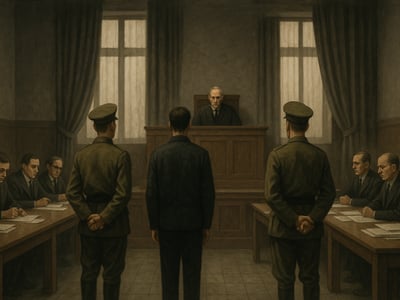
Viliam Žingor after the Bratislava political trial that ended with a death sentence in 1950.
On 21 October 1950, a court in Bratislava sentenced Viliam Žingor to death at the end of a three-day trial in communist Czechoslovakia. The verdict came six years after Žingor had served as a partisan commander during the Slovak National Uprising, an armed revolt that began on 29 August 1944 against the German-backed Slovak state. In official court language, he was now presented not as a wartime resistance figure but as a criminal defendant accused of treason and espionage.
That shift captures much of the political atmosphere of early 1950s Czechoslovakia. After the communist seizure of power in February 1948, the state moved quickly to tighten control over public life, political institutions, and the courts. Trials increasingly became part of that process. They were not only judicial proceedings but also public demonstrations of power, used to define loyalty, isolate enemies, and reshape the recent past in ways that supported the new order.
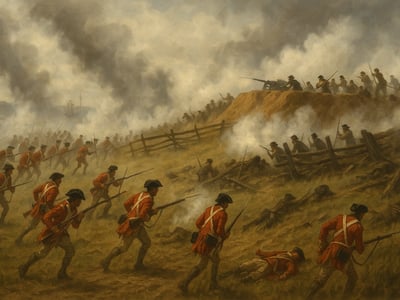
Žingor's background made his case especially striking. During the Second World War, he had taken part in the armed resistance associated with the Slovak National Uprising. That uprising has remained one of the central events in modern Slovak history: a military and political challenge to the wartime regime aligned with Nazi Germany. Men who fought in it could later be remembered as patriots, anti-fascists, or military actors whose place in the postwar state seemed secure.
Yet postwar politics did not leave such reputations untouched. As communist power consolidated, former resistance fighters did not automatically fit into the new hierarchy. Their wartime credentials could be honored, ignored, or reinterpreted depending on political alignment and usefulness to the regime. In that setting, a man once associated with anti-Nazi struggle could also become vulnerable to accusations that cast him as an enemy of the socialist state.
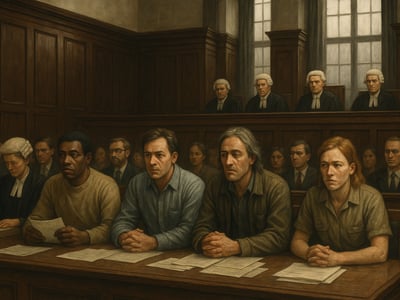
From 19 to 21 October 1950, Žingor was tried in Bratislava. The prosecution charged him with treason and espionage, two accusations that appeared frequently in the political language of the era. Such charges carried a particular force because they suggested not just disagreement or disobedience, but betrayal of the state itself and connection to hostile outside forces. In a system determined to identify internal opponents, that framing left little room for a defendant's earlier service or public standing.
The speed of the proceedings also mattered. A three-day trial ending in a death sentence reflected the harshness of the period and the limited protection available in politically charged cases. Courts in communist Czechoslovakia in 1950 operated in a climate where outcomes in important political matters were closely bound to the priorities of the regime. The legal process could provide the form of justice while serving political aims that had been established elsewhere.
In Slovakia, these years brought particular pressure on people who stood outside the party line or who represented alternative sources of wartime legitimacy. Former fighters, non-communist public figures, clergy, and others could all come under suspicion. The state did not need to deny that someone had opposed fascism in 1944; it could instead argue that past service did not excuse present disloyalty. This was one way the regime absorbed the symbolic authority of the resistance while disciplining those who did not fully belong to its version of the postwar order.
The case also sits within a wider regional pattern. Across the Soviet bloc in the late 1940s and early 1950s, courts were used to punish real, alleged, or constructed opponents through trials that carried a strong political message. Confessions, charges, and verdicts often did more than address individual conduct. They helped teach the public how the state understood danger, patriotism, and obedience. In that sense, Žingor's trial was about one man, but also about the boundaries of acceptable memory and political identity.
The sentence pronounced in Bratislava on 21 October 1950 was final in the most literal sense. Viliam Žingor was executed on 18 December 1950. The interval between sentencing and execution was short, and it closed the case in the way the authorities intended: not merely with conviction, but with irreversible punishment.
His story remained significant long after his death because it brought together two powerful and conflicting narratives of the same life. One was the narrative of wartime resistance, tied to the uprising of 1944 and to armed struggle against a fascist-aligned regime. The other was the narrative created by the post-1948 communist state, which used criminal proceedings to define him as a traitor. The distance between those two versions is one of the clearest measures of the political transformation that Czechoslovakia underwent in the space of a few years.
Why it still matters
Žingor's trial continues to matter because it shows how courts can be drawn into the work of political consolidation. The case was not only about guilt or innocence in a narrow legal sense; it was part of a broader system in which criminal law helped enforce party control. For historians of communist Czechoslovakia, it is a concrete example of how repression operated through institutions that formally claimed legality.
It also illustrates how states can redefine the meaning of earlier service. Wartime resistance did not provide permanent protection once the political framework changed. A person celebrated under one set of conditions could be condemned under another, not because the past had altered, but because the state had changed the language through which that past was interpreted.
Research after 1989, including archival work and the reassessment of political trials, has made such cases central to understanding communist-era justice in Slovakia and Czechoslovakia more broadly. Žingor's name appears in that work not only as an individual victim, but as part of a larger question: how legal systems record power, and how later generations try to disentangle law from coercion in the historical record.
Remembering the case does not require dramatic treatment. Its importance lies in the documentary facts: a resistance commander, tried in Bratislava from 19 to 21 October 1950, condemned for treason and espionage, and executed less than two months later. Those facts are enough to show how sharply postwar political life could turn, and how a state could recast a former partisan as a public enemy.
Timeline
- Slovak National Uprising begins
- Communist takeover in Czechoslovakia
- Trial begins in Bratislava
- Death sentence in Bratislava
- Execution in Bratislava
What you uncovered
When Legitimacy Was Rewritten
You didn't just… complete a puzzle; you traced the path by which a former partisan commander was turned into a political defendant by the postwar state.
Žingor's case highlights how regime change can alter not only who holds power, but also which past actions are treated as honorable or criminal. In 1944, armed resistance could be presented as legitimate struggle; by 1950, official legal language placed that same figure within categories like treason and espionage. That shift helps explain how political trials worked as tools for redefining loyalty, not simply punishing individual acts.
Viliam Žingor was tried in Bratislava from 19 to 21 October 1950 and was executed less than two months later, on 18 December 1950.
FAQ
What happened to Viliam Žingor on 21 October 1950?
On 21 October 1950, a court in Bratislava sentenced Viliam Žingor to death. His trial had taken place from 19 to 21 October 1950.
Who was Viliam Žingor?
Viliam Žingor was a former Slovak partisan commander. He had served during the 1944 Slovak National Uprising.
What charges were brought against Žingor in 1950?
He was tried in Bratislava on charges of treason and espionage. The authorities presented the case as part of a political prosecution in communist Czechoslovakia.
Why is Žingor connected to the Slovak National Uprising?
Žingor had been a partisan commander in the 1944 Slovak National Uprising. That is why his later prosecution stood in sharp contrast to his wartime role.