
About this story
On 2 November 1938, Germany and Italy issued the First Vienna Award at the Belvedere, requiring Czechoslovakia to transfer southern Slovakia and part of Subcarpathian Rus to Hungary. Košice, Uzhhorod, and Mukachevo changed states. Evacuation was to run from 5 to 10 November. The 1947 peace treaty later voided the award.
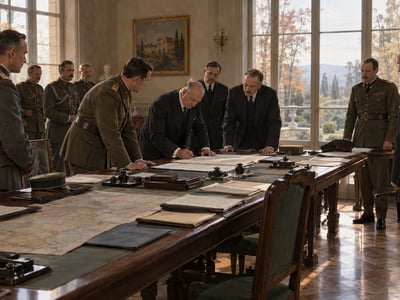
The First Vienna Award was signed at Belvedere Palace in Vienna on 2 November 1938.
On 2 November 1938, Germany and Italy issued the First Vienna Award at the Belvedere Palace in Vienna, requiring Czechoslovakia to transfer territory in southern Slovakia and part of Subcarpathian Rus to Hungary. The decision placed communities, including the cities of Košice, Uzhhorod and Mukachevo, on the Hungarian side of a new frontier. For residents, the change did not necessarily mean leaving home: it meant that the state governing their home would change.
After Munich, a second territorial demand
Slovakia was then an autonomous part of Czechoslovakia, not an independent state. Subcarpathian Rus was also part of Czechoslovakia, but it was a distinct territory and should not be treated as part of Slovakia when describing the award. Both were affected by a decision reached amid the wider territorial crisis that followed the Munich Agreement of September 1938.
The Czechoslovak-Hungarian frontier had emerged from the settlements after the First World War, including the Treaty of Trianon in 1920. Hungary sought revision of that settlement. The presence of Hungarian-speaking communities within Czechoslovakia was central to its claims, but language and national identification did not produce a simple or universally accepted boundary. Any redrawing of the frontier would also determine which residents became members of a national minority within another state.
Talks at Komárno, then outside arbitration
Czechoslovak and Hungarian representatives attempted to settle the territorial dispute through direct negotiations in Komárno from 9 to 13 October 1938. Those talks ended without agreement. The two governments subsequently submitted the dispute to German and Italian arbitration, moving the decisive stage of border-making away from bilateral negotiation and into the hands of outside powers.
German foreign minister Joachim von Ribbentrop and Italian foreign minister Galeazzo Ciano signed the award on 2 November. Hungarian foreign minister Kálmán Kánya and Czechoslovak foreign minister František Chvalkovský were involved in the proceedings. Jozef Tiso, head of Slovakia’s autonomous government, also participated in the territorial negotiations. Their roles were different: the German and Italian ministers issued the arbitration decision, while the representatives of the states and territories concerned faced its consequences.
Cities placed on the Hungarian side
The boundary attached to the award placed Košice in the territory to be transferred from Slovakia to Hungary. It also included Uzhhorod and Mukachevo in the transferred portion of Subcarpathian Rus. These cities illustrate the geographical reach of the settlement, but they were not isolated points on a map. The award also affected the surrounding communities and their connections to administrative centres, public institutions and neighbouring settlements.
The timetable was short. The award stipulated that Czechoslovakia’s evacuation of the territory and Hungary’s occupation of it would begin on 5 November and be completed by 10 November. Officials therefore had only days to prepare for the transfer. The arbitration date was not itself the date on which Hungarian forces entered every affected locality; the award established a period during which the change was to take place.
A short timetable and a later voiding
For residents, the transfer raised immediate questions about dealings with public authorities, citizenship and minority status. A person’s language, family ties and understanding of national identity did not automatically change with the frontier. Nor can the positions taken by governments be assumed to represent the views of everyone in the affected territory. Communities contained different identities and interests, and their experiences cannot be reduced to a single national response.
Why it still matters
The First Vienna Award shows how international arbitration can shift control over a territorial dispute from the negotiating states to outside powers. Although it took the form of an arbitration settlement, it was issued in the particular political circumstances of 1938, with Germany and Italy acting as the decision-makers. Understanding who held that authority is essential to understanding the resulting border.
It also connects diplomatic history with the everyday operation of government. A frontier determines more than the outline of a state: it establishes which authorities administer a town and the framework within which residents deal with public institutions. When the frontier changes, people who remain in the same place may find their relationship to the state substantially altered.
The award was not a permanent settlement. Hungary’s occupation of the remaining Carpatho-Ukraine in March 1939 was a separate development, not part of the November transfer. After the Second World War, the 1947 peace treaty with Hungary declared the Vienna awards null and void. These later events are important, but they should not be folded into the decision made at Vienna in November 1938.
The award’s historical significance lies in the connection between a diplomatic decision and the communities it placed under another state’s administration. Its boundary could be drawn on paper in Vienna; its consequences were experienced in the towns and villages through which that boundary reorganized public life.
Timeline
- Komárno negotiations end
- First Vienna Award
- Evacuation begins
- Occupation completes
- Peace treaty with Hungary voids the award
What you uncovered
Between Decision and Daily Life
You didn't just solve a puzzle; you revisited a border decision that changed state administration for communities in southern Slovakia and Subcarpathian Rus.
An arbitration award records what authorities prescribed, not necessarily how every community experienced the transfer. Understanding how outside powers’ boundary decisions became changes in public administration requires reading the award alongside local implementation records. Any difference between the prescribed process and events on the ground must be established through evidence rather than assumed.
The award stipulated that Czechoslovak evacuation and Hungarian occupation of the ceded territory would begin on 5 November 1938 and finish by 10 November.
FAQ
What was the First Vienna Award on 2 November 1938?
It was an arbitration award issued by Germany and Italy at the Belvedere Palace in Vienna. The decision required Czechoslovakia to transfer southern Slovak territory and part of Subcarpathian Rus to Hungary.
Which officials signed the First Vienna Award?
Joachim von Ribbentrop and Galeazzo Ciano signed the award on behalf of Germany and Italy. They were the German and Italian foreign ministers.
Which places were included in the territory awarded to Hungary?
The boundary attached to the award placed Košice, Uzhhorod and Mukachevo within the territory to be transferred to Hungary. The detailed frontier was left to a Hungarian-Czechoslovak commission.
When did the transfer and occupation begin after the award?
The award stipulated that evacuation by Czechoslovakia and occupation by Hungary would begin on 5 November 1938. The process was to finish by 10 November 1938.