
About this story
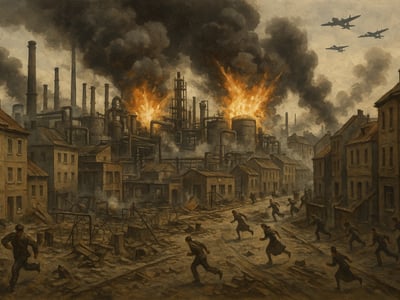
Bratislava and the Apollo refinery after the 16 June 1944 air raid.
On 16 June 1944, bombers of the United States Fifteenth Air Force attacked Bratislava, then part of the wartime Slovak Republic, in a raid that brought the Allied air war directly over the city. Among the main targets was the Apollo refinery, a major industrial site whose fuel production had made it strategically important in the Allied campaign against Axis oil infrastructure. The attack caused severe damage to the refinery and also struck surrounding urban areas, leaving a lasting place in Bratislava's memory of the Second World War.
By mid-1944, oil had become one of the most important objectives of Allied strategic bombing. Armies, air forces, transport systems, and industry all depended on fuel. For Allied planners, refineries and other petroleum facilities were not secondary targets but central ones. Destroying them could weaken military mobility and industrial output far from the front line. The Fifteenth Air Force, operating from bases in Italy, was heavily involved in this effort and flew long-range missions against targets across Central and Southeastern Europe.
Bratislava fit into that larger picture because the Apollo refinery was an important processing site inside a populated city. That fact shaped the danger of the mission from the beginning. This was not an attack on an isolated depot in open countryside. It was an attempt to cripple fuel production in a place where industrial buildings, transport links, and civilian neighborhoods stood close together. Even if the intended target was clearly military-economic in Allied planning terms, the risks for residents on the ground were immediate.
The attacking aircraft approached from long range under wartime conditions that always complicated bombing accuracy. Aircrews had to find, identify, and bomb a specific industrial complex after a long flight from Italy. In such operations, weather, visibility, timing, and defensive pressure could all affect the outcome. A mission could fail by missing the target, scattering bombs too widely, or inflicting heavy urban destruction without fully stopping production. Those possibilities were built into the nature of strategic bombing.
In Bratislava, the bombs did hit the Apollo refinery. Accounts of the raid state that about 80 percent of the refinery complex was destroyed. That figure helps explain why the attack is remembered as one of the most consequential wartime air raids on the city. The refinery was not lightly damaged or temporarily interrupted; it was devastated. For Allied strategy, that meant a major blow against a fuel facility. For the city, it meant fire, wreckage, and destruction in an industrial zone closely tied to everyday urban life.
The bombing did not remain confined to machinery and storage facilities. Urban districts around the target area were also damaged, exposing civilians to the consequences of a strike aimed at industrial infrastructure. This dual reality is essential to understanding the raid. In military terms, the refinery was a legitimate strategic objective within the Allied oil campaign. In human terms, the attack unfolded over a living city where workers, families, and local institutions were vulnerable to blast, fire, and collapsing buildings.
One of the most difficult aspects of the event is the question of casualties. Published accounts report different fatality totals, and there is no single number that can be presented without qualification. Some figures come from local records, some from later historical works, and some reflect the problems common in wartime reporting, including incomplete documentation and differing methods of counting the dead. For that reason, the human cost is best described carefully: the raid killed civilians and caused loss of life on a significant scale, but any exact total depends on the source being used.
The place names associated with the bombing also matter. The Apollo refinery itself stands at the center of the story, but damage affected broader parts of Bratislava, including areas linked in accounts of the raid such as Podunajské Biskupice. This reminds us that wartime bombing was rarely experienced as a single point on a map. A target might be named precisely in military planning, yet the impact spread outward through streets, homes, workplaces, and transport routes.
The raid also illustrates how the air war connected places that seemed far apart. Decisions taken by Allied planners, crews departing from Italian bases, and industrial production inside the Slovak Republic all converged over Bratislava in a matter of hours. The city became part of a much wider campaign in which fuel infrastructure across Europe was being attacked as the Allies tried to reduce the Axis capacity to continue the war.
Why it still matters
The bombing of Bratislava on 16 June 1944 still matters because it shows the central dilemma of strategic bombing in modern war. Refineries and fuel plants were vital military targets, yet they were often embedded in working cities. The Apollo raid demonstrates how an attack designed to disrupt logistics and industry could also devastate civilians living beside the target.
It also remains important in local historical memory. Records of damage, commemorative practices, and later historical interpretation have kept the raid present in Bratislava's understanding of the war years. The event is remembered not only as a military operation but also as a civic trauma that affected neighborhoods, workers, and families.
Finally, the destruction of the Apollo refinery helps explain the logic of the late-war Allied oil campaign. By 1944, petroleum facilities had become central targets because fuel shortages could weaken transport, production, and military operations all at once. The Bratislava raid is therefore both a local story and part of a larger history of how industrial systems became decisive objectives in twentieth-century warfare.
What remains most striking is the way the raid joined strategy and daily life in a single moment. The attack was planned in the language of targets, sorties, and oil supply, but it was experienced in Bratislava as falling bombs, damaged neighborhoods, and uncertain casualty lists. That combination of military purpose and civilian vulnerability is why the raid continues to be studied with both strategic interest and human caution.
Timeline
- Allied oil campaign
- Slovak Republic during World War II
- Apollo refinery in operation
- Air defenses in Bratislava
- Air raid on Bratislava
- Postwar reconstruction in Bratislava
What you uncovered
Industry Inside the City
You didn't just… complete a puzzle; you traced a wartime moment when attacking fuel infrastructure also meant exposing a populated city to destruction.
The Bratislava raid shows a central tension of the late-war oil campaign: the military logic was aimed at fuel production, but the effects could not be confined to refinery grounds alone. When a key industrial site sat inside a capital city, strategy and civilian vulnerability became part of the same problem. That is one reason this event remains important in local memory as both an industrial strike and an urban tragedy.
The attacking Fifteenth Air Force flew from bases in Italy, and accounts of the raid state that about 80% of the Apollo refinery complex was destroyed.
FAQ
What happened in Bratislava on 16 June 1944?
On 16 June 1944, B-24 bombers of the United States Fifteenth Air Force attacked Bratislava. The raid hit industrial and urban areas of the city during World War II.
Why was the Apollo refinery targeted?
The Apollo refinery was one of the principal targets because fuel infrastructure was a priority in the Allied oil campaign. It was part of the effort to disrupt Axis-controlled fuel supplies in mid-1944.
How much of the Apollo refinery was destroyed?
Accounts of the attack state that about 80% of the Apollo refinery complex was destroyed on 16 June 1944. The raid caused extensive damage to the site.
Why do casualty figures for the bombing differ?
Published accounts of the bombing report differing fatality totals. Any casualty figure should be tied to the specific source being cited rather than treated as a single settled number.