
About this story
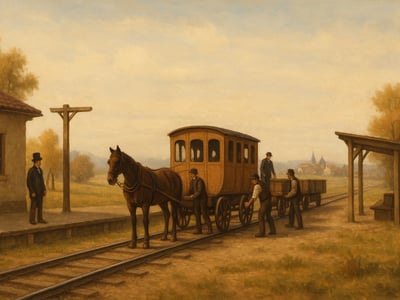
On 27 September 1840 the Bratislava–Svätý Jur section of a horse-drawn railway opened to regular traffic, the first railway stretch in service on the territory of present-day Slovakia. It formed part of the Bratislava–Trnava line in the Kingdom of Hungary. An earlier Pressburg section had seen public service in March 1840.
Opening of the Bratislava–Svätý Jur horse railway section in 1840.
On 27 September 1840, traffic began on the first opened section of the horse-drawn railway between Bratislava and Svätý Jur. In the transport history of present-day Slovakia, that moment is generally recognized as the first railway section put into regular service on its territory. At the time, however, this was not a project of a modern Slovak state, but part of a larger infrastructure effort within the Kingdom of Hungary, where investors and operators were looking for more efficient ways to move goods and people than ordinary road traffic could provide.
Rails before steam
The line from Bratislava to Svätý Jur did not appear in isolation. It belonged to the broader Bratislava–Trnava horse railway project, an undertaking shaped by the practical needs of the early 19th century. Roads were often slow, seasonally unreliable, and costly for hauling larger loads. A fixed route with rails offered a different approach: wagons could move with less rolling resistance than on rough roads, and transport could become more regular and predictable. Before steam railways became the standard image of rail transport, horse traction was a workable intermediate form.
That intermediate character is one of the most important things about the 1840 opening. Later railway history is so strongly associated with locomotives, smoke, and industrial speed that horse-drawn railways can seem like an odd preliminary experiment. Yet in many parts of Central Europe, they were a serious technological and commercial answer to local conditions. Building a railway did not necessarily mean waiting for steam power to be available everywhere at once. It could also mean adopting rails first, improving the route, and using animal traction to make the system function.
Bratislava to Svätý Jur
The Bratislava–Svätý Jur section showed that such a model could be put into operation in the region northeast of the city. Svätý Jur was close enough to Bratislava to make the opening immediately practical, but distinct enough to demonstrate that a rail connection could link the urban center with nearby settlements and market areas. Even a relatively short opened section could test organization, maintenance, traffic patterns, and the public's willingness to use a new mode of transport.
For the company behind the broader route, the stakes were real. Planning and financing a railway required confidence that the line would not remain a costly curiosity. Tracks had to be laid, operations arranged, and a system created in which horses, wagons, schedules, and handling points worked together. If the line had attracted too little use, or if construction had stalled before the larger project advanced, the undertaking might have been remembered as an ambitious but unsuccessful early venture. Instead, the opening entered the historical record as a concrete beginning.
A regional line in the Kingdom of Hungary
The fact that this first section connected Bratislava with a town to its northeast also mattered in economic terms. Railways were not built merely to symbolize progress. They were expected to support movement: agricultural products, commercial goods, and passengers all stood to benefit from a more stable and organized transport corridor. In an era before rail networks spread widely across the region, even one functioning section could alter assumptions about distance, timing, and access to markets.
It is also important to place the event in its political and historical setting. In 1840, Bratislava was part of the Kingdom of Hungary within the Habsburg Monarchy. The categories by which the line is remembered today are therefore layered. Modern Slovak transport history identifies the Bratislava–Svätý Jur opening as the first railway section placed in service on the territory of present-day Slovakia. That is a geographically accurate way of locating its importance, but the builders and operators were acting within a different state framework. The event belongs both to local history and to the larger infrastructure history of the monarchy.
An early proof of scheduled transport
This dual perspective helps explain why the line attracts continued interest. It was an early railway, but not yet a steam railway. It was local in operation, but part of a larger regional project. And it is remembered through present-day national historiography, even though it emerged under 19th-century imperial and Hungarian administrative structures. Those layers do not contradict one another; they show how infrastructure can outlast the political maps under which it was first created.
The opening to Svätý Jur was also only one stage in a longer story. The Bratislava–Trnava project extended beyond this initial section, and the broader development of rail transport in Central Europe would soon be shaped by steam traction and network expansion. In that sense, the 1840 service beginning was not the final form of the railway future in the region. It was an early operational proof that fixed-track transport had a place there. Once that principle had been established in practice, later technological change could build on it.
Why it still matters
The opening of the Bratislava–Svätý Jur horse railway still matters because it marks a clear early step in the transition from road-based hauling to rail-based transport in the territory of present-day Slovakia. It reminds us that railway history was not born fully formed with steam locomotives already dominant. In many places, the path to modern rail systems involved intermediate solutions that combined older sources of motive power with newer infrastructure.
The line also illustrates how transport modernization often begins with regional needs rather than grand national systems. A connection between a major town and nearby settlements could have lasting significance if it established routines of scheduled movement, fixed routes, and dedicated infrastructure. What later generations recognize as the beginning of a railway era may start with a modest section rather than a vast network.
Finally, the story helps explain how modern historical memory works. The 1840 opening is interpreted today through the geography of present-day Slovakia, even though it took place within the Kingdom of Hungary. That does not reduce its importance; it shows how infrastructure history can connect different political periods. The rails laid for one age can become a landmark in the story told by another.
Seen from that perspective, the first traffic between Bratislava and Svätý Jur was more than a local transport improvement. It was an early sign that movement in the region was beginning to be reorganized around tracks, timetables, and planned connections—an approach that would shape Central European transport far beyond the age of horse traction.
Timeline
- Earlier public service on a Pressburg horse-railway section
- Bratislava–Svätý Jur section opens to regular traffic
- Broader Bratislava–Trnava horse railway develops
What you uncovered
Before the Age of Steam
You didn't just… complete an image; you traced the start of rail transport on the territory of present-day Slovakia at a moment when fixed tracks were still being tested with horse traction.
This line belongs to a transitional phase in transport history, when railways were not yet defined by locomotives but by the idea of guiding movement along a fixed route. Horse-drawn service could still reduce friction, regularize travel, and tie nearby markets more closely to a city. Seen that way, the section between Bratislava and Svätý Jur was less an outdated curiosity than an early step toward the network logic that later steam railways expanded.
The Bratislava–Svätý Jur section opened on 27 September 1840 as part of the larger Bratislava–Trnava horse railway project in the Kingdom of Hungary.
FAQ
What happened on 27 September 1840 in Bratislava?
On 27 September 1840, service began on the Bratislava–Svätý Jur section of a horse-drawn railway. It was opened to traffic as part of the larger Bratislava–Trnava horse railway project.
Where did the first opened section of the horse railway run?
The opened section connected Bratislava with Svätý Jur, a settlement northeast of the city. The route lay within the Kingdom of Hungary and on the territory of present-day Slovakia.
Why is this railway section historically important?
In Slovak transport historiography, this 1840 opening is identified as the first railway section placed into service on the territory of present-day Slovakia. It is treated as an early step in rail transport development in the region.
Was this line part of a larger railway project?
Yes. The Bratislava–Svätý Jur section was part of the broader Bratislava–Trnava horse railway project. The opened section was one part of that wider route.