About this story
On 30 October 1918, more than 200 Slovak representatives met in Turčiansky Svätý Martin and adopted the Declaration of the Slovak Nation. The Slovak National Council, chaired by Matúš Dula, acted two days after the Czechoslovak state was proclaimed in Prague on 28 October. Figures linked to the meeting include Vavro Šrobár, Milan Hodža, and Samuel Zoch. On 11 November, Emperor Charles I renounced participation in state affairs.
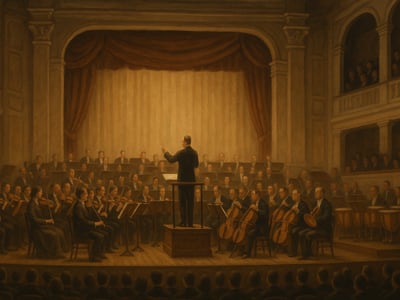
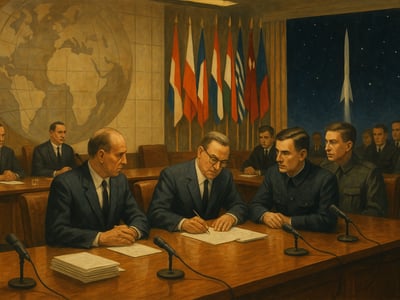
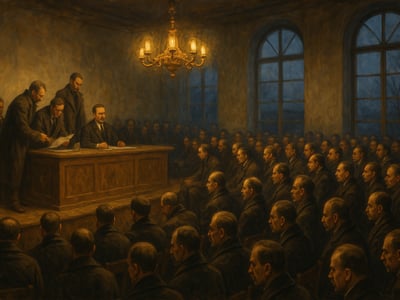
Meeting in Turčiansky Svätý Martin where the Martin Declaration was adopted in 1918.
On October 30, 1918, more than 200 representatives of Slovak political, civic, and cultural life gathered in Turčiansky Svätý Martin and adopted the Declaration of the Slovak Nation. The meeting took place in the final days of the Austro-Hungarian Monarchy, when imperial authority was rapidly collapsing at the end of the First World War. In that unstable setting, the assembly in Martin was an effort to state a common Slovak political position at a moment when borders, governments, and loyalties were being redefined in real time.
Two days after the proclamation in Prague
The timing mattered. Just two days earlier, on October 28, 1918, the Czechoslovak state had been proclaimed in Prague. That announcement gave a new political framework to events in the lands of the former monarchy, but it did not remove the need for local and regional bodies to speak for themselves. In Upper Hungary, where most Slovaks lived within the Hungarian half of the Habsburg state, political conditions were changing quickly, but not in an orderly or fully settled way. Communication was uneven, state institutions were weakening, and any public declaration carried both symbolic and practical weight.
The body that met in Martin was the Slovak National Council, which had emerged in 1918 as an important political organ for Slovak representation. Its task was not simply ceremonial. It had to gather support, present a recognizable leadership, and formulate a text that could be understood as speaking for a broader public. In periods of state breakdown, legitimacy is often asserted through visible acts: convening an assembly, recording agreement, appointing officers, and issuing a declaration. The reported participation of more than 200 representatives gave the Martin meeting a measurable scale and helped show that this was more than a private consultation among a few individuals.
Matúš Dula chaired the meeting. Among the figures associated with the political activity of the period were Vavro Šrobár, Milan Hodža, and Samuel Zoch. Their presence in the historical record reflects a wider network of Slovak public life that included politicians, intellectuals, clergy, and community leaders. What made the Martin gathering significant was not only the names involved, but the attempt to bring these strands together in one place and express a common position despite uncertainty.
The Slovak National Council states a position
That uncertainty was substantial. The Austro-Hungarian state structure had not vanished all at once. Authority was breaking apart unevenly, and local actors had to decide how quickly to move, what language to use, and how far they could claim to speak on behalf of others. A meeting of this kind could have faltered in several ways. Attendance might have been too limited to carry political weight. Delegates might have disagreed on wording. The assembly might have ended without a text that later institutions would recognize as consequential. Instead, the participants approved a document that became commonly known as the Martin Declaration.
The declaration marked Slovak political alignment during the transition from empire to a new state order. In historical discussion, the document is usually treated as a key statement linking Slovak representation to the formation of Czechoslovakia. That connection is one reason the date remains prominent in accounts of 1918. The proclamation in Prague on October 28 established one turning point; the meeting in Martin on October 30 showed how that broader change was answered and articulated by Slovak representatives within their own political setting.
A declaration while the empire was still breaking
The location also mattered. Turčiansky Svätý Martin had long held an important place in Slovak cultural and political life, making it a meaningful site for an assembly intended to project collective authority. In moments of transition, place can reinforce message. A declaration issued from a known center of public activity carries a different resonance than one circulated privately or drafted in isolation. Martin offered not just a meeting hall, but a recognizable civic stage.
The event belongs to a narrow window of extraordinary speed. Within less than two weeks, the old imperial order moved decisively toward its end phase. On November 11, 1918, Emperor Charles I renounced participation in state affairs, a step closely associated with the final collapse of Habsburg rule. The Martin meeting came before that formal marker, while the situation was still unsettled. That is part of what gives the assembly its historical importance: the participants acted during uncertainty, not after the outcome had become fully secure.
Why it still matters
The Martin meeting remains important because it shows how political communities make themselves visible during moments of state transition. Representative assemblies, named leadership, and formal declarations are not minor procedural details. They are among the ways legitimacy is publicly constructed when older institutions are losing authority and new ones are not yet fully established.
It also illustrates how regional representation connected to a larger national framework. The creation of Czechoslovakia was not only a matter of decisions in Prague. It also depended on how local and regional actors positioned themselves, organized support, and expressed consent or alignment. The assembly in Martin is therefore part of the institutional history of Slovak participation in the founding of the new state.
Finally, the event offers a concrete reminder that political change is often shaped by gatherings that must quickly transform uncertainty into a document, a claim, and a record. The reported attendance of more than 200 representatives does not tell the whole story, but it helps show the scale of the effort. In that crowded room in Martin, public presence itself became part of the historical act.
Timeline
- Czechoslovak state proclaimed in Prague
- Martin Declaration adopted
- Charles I steps back from state affairs
What you uncovered
Representation in a Breaking Empire
You didn't just place a historical detail—you reconstructed how Slovak representatives publicly expressed a shared political position as imperial authority was falling apart.
The reported attendance matters not only as a number, but as a visible claim to legitimacy. In 1918, authority in many places was being improvised in real time, so assemblies, declarations, and recognizable representatives helped show that a political decision had broader backing. The Martin meeting illustrates how public presence could stand in for later, more formal democratic mechanisms during a fast-moving state transition.
The Martin meeting took place two days after the proclamation of Czechoslovakia in Prague on 1918-10-28.
FAQ
What happened in Turčiansky Svätý Martin on 30 October 1918?
On 30 October 1918, the Slovak National Council met in Turčiansky Svätý Martin and approved the Declaration of the Slovak Nation. The document adopted there is commonly called the Martin Declaration.
Who chaired the Martin meeting in 1918?
Matúš Dula served as chairman of the Slovak National Council at the Martin meeting on 30 October 1918.
Why did Slovak representatives gather in Martin at that time?
They gathered to organize and state a common political position during the collapse of Austro-Hungarian authority at the end of the First World War. The meeting was meant to express collective representation in a rapidly changing situation.
How did the Martin meeting relate to the founding of Czechoslovakia?
It took place two days after Czechoslovakia was proclaimed in Prague on 28 October 1918. The Martin declaration became part of the Slovak political response during the creation of the new state.