

About this story
Opening of the Paris 2024 Summer Olympics, with Slovakia among participating countries
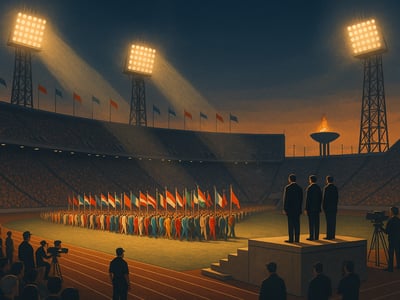
On 26 July 2024, the Summer Olympic Games opened in Paris, France, starting an edition scheduled to run until 11 August 2024. For the host city, the date marked the beginning of one of the world’s largest sporting events. For participating countries such as Slovakia, it marked something more specific: the moment when years of qualification attempts, administrative preparation, and delegation planning became an official Olympic presence.
The opening of the Games is always ceremonial, but it is also practical. By the time the Olympic flame is lit and the host city presents itself to the world, national Olympic committees have already spent years working through qualification systems, athlete entries, travel arrangements, accreditation, and final confirmations. That process is less visible than competition itself, yet it determines whether a country arrives at the opening of the Games fully prepared to take part.
Paris 2024 brought that transition into public view. The opening ceremony, held in Paris and closely associated with the Seine River setting, turned preparation into spectacle. It showed the Games not as an abstract future event but as an active reality, with athletes, officials, and delegations now present under the authority of the Olympic schedule. For host organizers, it was the public launch of an event planned over many years. For each participating nation, it was the fixed deadline that separated being expected at the Olympics from actually being there.
Slovakia was among the nations participating in the 2024 Summer Olympics. In the wider context of the Games, Slovakia’s delegation for Paris 2024 was reported as 28 athletes competing under the Slovak flag. That figure described the country’s overall delegation for the Olympics, not a separate opening-day count. This distinction matters because the opening ceremony and a national roster are related, but they are not identical things.
A country’s Olympic delegation reflects the athletes entered for the Games as a whole. The opening of the Games, by contrast, is a milestone at which that broader participation becomes publicly visible. Some athletes may arrive on different schedules depending on training, competition timetables, or logistical needs. Others may be focused on events beginning soon after the Games open. The official existence of a national team at the Olympics therefore depends on more than who appears in a ceremony at one moment.
That is why the opening day carries a quiet administrative significance beneath the global spectacle. A delegation must be more than symbolic. Entries must be recognized, accreditation must be in order, travel must be completed or coordinated, and athletes must be ready for the start of competition. If any part of that chain is delayed, a country can still be participating in principle while facing complications in how fully and smoothly it appears at the opening stage of the event.
For Slovakia, as for many countries with smaller delegations than the largest sporting powers, the opening of the Paris Olympics highlighted this balance between visibility and organization. The world sees flags, boats, ceremonies, and national representation. Behind that image stands a process managed by sporting institutions, in Slovakia’s case the Slovak Olympic and Sports Committee, which entered the country in the Paris 2024 Games. By the opening date, the task was no longer to pursue qualification in theory. It was to have the delegation formally and practically in place.
The Paris Games also fit into a longer story of Olympic participation by Slovakia as an independent state. Every Summer Olympics requires a fresh cycle of qualification and confirmation. Athletes do not simply inherit a place from one edition to the next; they must meet the standards and pathways established for each sport. That makes every opening ceremony both familiar and new. The national flag may be the same, but the roster has been assembled through a current, time-bound process.
This is one reason opening ceremonies remain important even for people more interested in competition than pageantry. They are not only cultural performances. They are the public threshold at which the host city, the International Olympic Committee, and national committees all converge on a single timetable. The opening compresses years of venue planning, qualification rules, and team administration into one date that cannot be moved for any individual delegation.
Why it still matters
The opening of Paris 2024 remains useful as a clear example of how the Olympic system works in practice. A fixed start date forces coordination across many levels at once: the host city must be ready, international organizers must activate the event, and each participating country must convert intention into actual presence.
Slovakia’s participation helps show the difference between a national Olympic delegation and the narrower question of opening-day visibility. A reported 28-athlete delegation tells us about the country’s overall representation at the Games. The opening ceremony tells us when that representation became part of the public life of the Olympics. Those are connected facts, but not the same fact.
That distinction matters beyond one country or one Summer Games. It helps explain how global sports events are built from both spectacle and administration. Viewers may remember images from Paris, but institutions must also manage entries, schedules, accreditation, and readiness. The Olympics depend on both.
In that sense, 26 July 2024 was not only the day Paris opened its Games. It was also the day when countries including Slovakia crossed from preparation into participation, making visible the work required to appear on the Olympic stage at all.
Timeline
What you uncovered
From Roster to Presence
You didn't just… complete a puzzle; you traced the moment when Slovakia's Olympic participation shifted from entries and preparation into visible presence at the Games in Paris.
An Olympic delegation exists before the ceremony, in entry lists, quotas, and administrative approvals. But opening day gives that paperwork a public form, turning a planned national presence into something visible to audiences and institutions at the same time. Slovakia's reported 28-athlete delegation helps show the distinction: the full roster belonged to the Games as a whole, while the opening marked the point at which that participation became officially and publicly real.
The Paris 2024 Summer Olympics were scheduled to run from 26 July to 11 August 2024.
FAQ
What happened in Paris on 26 July 2024?
On 26 July 2024, the opening ceremony of the 2024 Summer Olympics was held in Paris, France. That ceremony marked the official start of the Paris 2024 Games.
How many athletes were in Slovakia's Paris 2024 delegation?
Slovakia's overall delegation for the 2024 Summer Olympics was reported as 28 athletes. They competed under the Slovak flag at Paris 2024.
Did Slovakia take part in the Paris 2024 opening ceremony?
Yes. Slovakia was among the nations participating in the 2024 Summer Olympics, and the Slovak Olympic and Sports Committee entered Slovakia in the Paris 2024 Games.
When did the Paris 2024 Olympics begin and end?
The Paris 2024 Olympic Games were scheduled from 26 July 2024 to 11 August 2024. The opening ceremony took place on 26 July 2024 in Paris, France.