
About this story
In the early hours of 24 September 1938 Adolf Hitler presented Neville Chamberlain with the Godesberg Memorandum at Bad Godesberg. After Berchtesgaden on 15 September, the written terms demanded a rapid handover of Sudeten areas. Czechoslovakia ordered general mobilization on 23 September; the Munich Agreement followed on 29–30 September.
Bad Godesberg talks during the Sudeten crisis, 24 September 1938
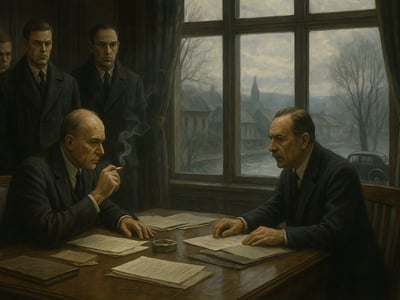
In the early hours of September 24, 1938, Adolf Hitler presented Neville Chamberlain with terms that became known as the Godesberg Memorandum, a document that sharply intensified the Sudeten crisis. Produced during talks at Bad Godesberg near Bonn, it demanded that Czechoslovakia rapidly evacuate and hand over predominantly Sudeten German areas according to a timetable set from outside Prague. What had seemed, only days earlier, to be a negotiation over principle now looked much more like coercion backed by the threat of war.
From Berchtesgaden to Godesberg
The crisis had been building throughout 1938. The Sudeten question centered on border regions of Czechoslovakia with large German-speaking populations, where the Sudeten German Party led by Konrad Henlein pressed demands that increasingly aligned with Berlin's policy. For Hitler, the issue became a means of exerting pressure on the Czechoslovak state. For Czechoslovakia, however, the borderlands were not only demographically sensitive; they were also strategically important, containing much of the country's fortified frontier defenses.
When Chamberlain met Hitler at Berchtesgaden on September 15, the British prime minister believed he was opening a path to avoid a European war through direct negotiation. By the time he traveled to Bad Godesberg on September 22, he expected to discuss the implementation of concessions already under consideration by Britain and France. Instead, the discussion shifted. Hitler moved beyond the earlier framework and presented a harder written set of demands.
That change mattered because written terms can narrow political room for compromise. The memorandum did not simply restate a claim to territorial transfer. It called for rapid evacuation and occupation arrangements in Sudeten areas on a fixed schedule proposed by Germany. In effect, it compressed time, reduced flexibility, and increased pressure on all the governments involved. A dispute that had been handled through meetings and proposals was recast as a deadline crisis.
A written timetable of coercion
For Chamberlain, this was a serious setback. His strategy depended on the assumption that concessions, however controversial, might produce a stable settlement. At Godesberg he was confronted with evidence that earlier movement had not closed the gap but widened it. British diplomacy now had to decide whether to continue bargaining under harsher terms or to acknowledge that the process itself was becoming unstable.
France faced a different but equally difficult calculation. It had alliance commitments connected to Czechoslovakia, yet it was also deeply tied to British mediation and to the wider fear that a general war could begin at any moment. The French government had to judge whether support for continued negotiation still served peace, or whether each new concession merely shifted the balance further against Prague without creating any durable guarantee.
Prague mobilizes
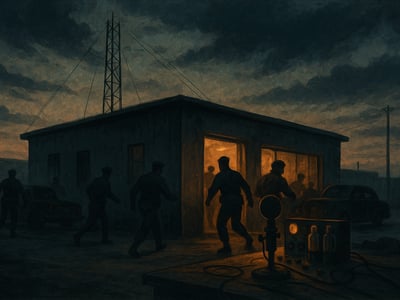
For the Czechoslovak government, led by President Edvard Beneš and officials in Prague, the stakes were immediate and concrete. The issue was not only loss of territory, but loss of defensible borders and control over the pace of events. On September 23, 1938, as the crisis worsened, Czechoslovakia ordered general mobilization. That step showed that the government was preparing for the possibility that diplomacy might fail within days. Mobilization also demonstrated that events were no longer confined to conference rooms and communiqués; state institutions were acting under the assumption that armed conflict could follow.
The memorandum therefore split the crisis into several decision arenas at once. In London, policymakers had to assess whether Hitler's latest demands were negotiable or whether they amounted to a near-ultimatum. In Paris, leaders had to weigh alliance, deterrence, and the risks of escalation. In Prague, officials had to consider whether any concession under these conditions remained politically or militarily tolerable. The same document reached each capital with a different meaning, but in all of them it increased urgency.
The road toward Munich
Bad Godesberg also revealed a recurring feature of interwar diplomacy: the vulnerability of a smaller state when larger powers negotiated over its territory in the name of preserving peace. Czechoslovakia was central to the crisis, yet key discussions were shaped elsewhere, above all between Germany, Britain, and France. This imbalance did not begin at Godesberg, but the memorandum made it more visible by setting terms that directly affected Czechoslovakia's sovereignty without emerging from normal agreement with its government.
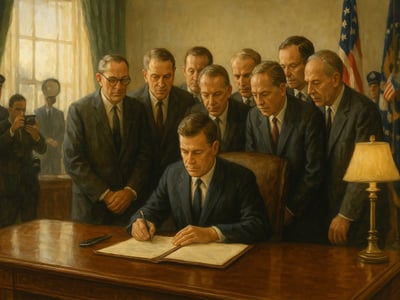
The days after Godesberg did not produce a durable bilateral settlement between Chamberlain and Hitler. Instead, the crisis moved toward a broader great-power conference. On September 29-30, 1938, Germany, Italy, Britain, and France signed the Munich Agreement, and Czechoslovakia was not a participant in the final decision. The path from Godesberg to Munich was not mechanically predetermined, but the memorandum marked a key escalation. It demonstrated that the earlier negotiating framework had broken down and that the pressure on Prague could be intensified rather than eased.
Why it still matters
The Godesberg episode remains important because it shows how diplomacy can be transformed by the form of a demand, not only by its content. A written text with a deadline and a fixed timetable can change negotiations before any formal declaration of war. It can turn discussions about principle into immediate decisions under duress.
It also remains a significant example of how the security of a smaller state can be reshaped by talks conducted mainly among larger powers. In the Sudeten crisis, Britain and France presented themselves as trying to preserve peace, yet the state most directly affected faced growing pressure to accept terms framed elsewhere. That pattern has made Godesberg a lasting reference point in discussions of sovereignty, mediation, and the limits of external guarantees.
Finally, the memorandum matters because it exposed the fragility of concessions not anchored by mutual trust or enforceable stability. At Bad Godesberg, movement toward compromise did not end the crisis. It sharpened it. For historians of appeasement, that moment is important not as a simple moral lesson, but as a concrete case in which negotiation, pressure, and fear of war interacted in ways that left Czechoslovakia increasingly isolated.
Timeline
- Chamberlain-Hitler meeting at Berchtesgaden
- Talks begin at Bad Godesberg
- Czechoslovak general mobilization
- Godesberg Memorandum presented
- Munich Agreement signed
What you uncovered
When Terms Become Pressure
You didn't just… complete a historical puzzle; you traced the moment when negotiations over Czechoslovakia were recast as pressure through written demands and deadlines.
Godesberg mattered not only because of what was demanded, but because of how the demand was framed. What had seemed like a negotiation after earlier talks was turned into a document with a rapid timetable, narrowing the space for genuine consent. That shift helps explain why the crisis is often remembered as more than failed diplomacy: it showed how procedure itself can be used to pressure a smaller state while larger powers debate peace around it.
On 23 September 1938, one day before the memorandum was presented, Czechoslovakia ordered general mobilization.
FAQ
What happened at Bad Godesberg on 24 September 1938?
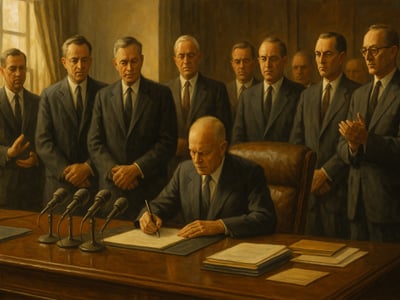
In the early hours of 24 September 1938, Adolf Hitler presented Neville Chamberlain with the terms later known as the Godesberg Memorandum. The document demanded rapid evacuation and transfer arrangements in Sudeten areas under a fixed German timetable.
Where did the Godesberg Memorandum come from?
It emerged from talks at Bad Godesberg near Bonn during the Sudeten crisis. Chamberlain had met Hitler there on 22 September 1938, after their earlier Berchtesgaden discussions.
What did the memorandum demand from Czechoslovakia?
It demanded that Czechoslovakia surrender Sudeten German-majority border territories on a rapid schedule. The terms called for accelerated occupation and territorial transfer arrangements in the border regions.
How did Czechoslovakia react to the crisis?
On 23 September 1938, the Czechoslovak government ordered general mobilization. This showed that Prague was preparing for the possibility that negotiations might fail.
How did the Godesberg crisis relate to the Munich Agreement?
The crisis helped push the dispute toward the Munich Agreement, which Germany, Italy, Britain, and France signed on 29-30 September 1938 without Czechoslovak participation. It marked the shift from bilateral bargaining to a broader settlement imposed by the major powers.