
About this story
On 29 September 1938 Germany, Italy, Britain, and France settled the Sudeten crisis in Munich without a Czechoslovak signature. Hitler, Mussolini, Chamberlain, and Daladier agreed that German forces would occupy specified Sudeten territories from 1 October. The next day Chamberlain and Hitler signed an Anglo-German declaration. Further losses followed, including the First Vienna Award on 2 November.
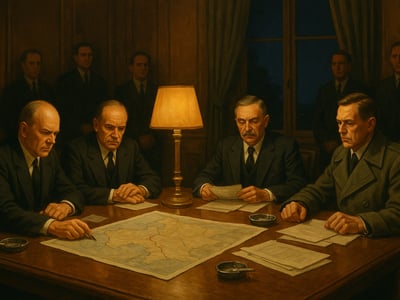
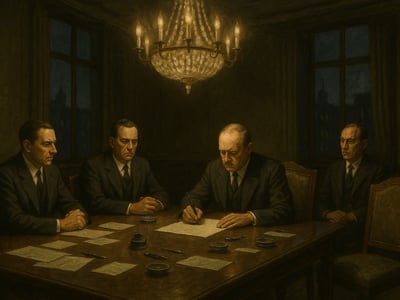
Munich Agreement negotiations in 1938 over the Sudeten areas of Czechoslovakia.
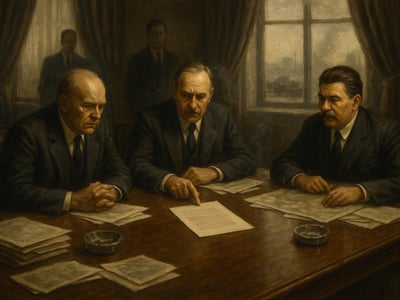
On 29 September 1938, representatives of Germany, Italy, the United Kingdom, and France gathered in Munich to address the Sudeten crisis, a dispute that had become one of the most dangerous diplomatic confrontations in Europe. By the end of the night of 29-30 September, Adolf Hitler, Benito Mussolini, Neville Chamberlain, and Édouard Daladier had signed what became known as the Munich Agreement. It provided for the transfer of the Sudeten border regions of Czechoslovakia to Germany, with German occupation of designated areas to begin on 1 October. Czechoslovakia, whose territory and defenses were directly at issue, did not take part as a party to the final four-power settlement, and President Edvard Beneš was not among its signatories.
Four powers and one crisis
The agreement came at the end of months of escalating pressure. In 1938, the status of the Sudeten borderlands had become the central point of an international crisis. Nazi Germany pressed claims connected to the German-speaking population in those regions, while the Czechoslovak state faced growing diplomatic and military strain. The issue was not only local. Czechoslovakia occupied an important place in the post-First World War order in Central Europe, and its frontiers were tied to broader questions of treaty guarantees, security, and the balance of power.
As the crisis deepened, the possibility of war appeared increasingly real. Czechoslovakia mobilized in September 1938, preparing for the risk of armed conflict. At the same time, Britain and France sought a settlement that would prevent immediate war. Their leaders judged that a negotiated territorial concession might contain the crisis. Germany, under Hitler, pressed for rapid resolution on its own terms, while Mussolini took part in the conference that brought the four powers together in Munich.
Czechoslovakia outside the signature
The structure of the meeting mattered as much as its outcome. The conference placed the decisive negotiations in the hands of four governments: Germany, Italy, the United Kingdom, and France. Czechoslovak representatives were present in Munich only in a marginal capacity and were not parties to the final agreement itself. This absence gave the settlement a particular historical meaning. It was not simply an international discussion about a disputed region; it was a diplomatic decision by major powers over the territory of a state that was not directly included in the final bargain.
The agreement signed during the night set out a timetable for the transfer. German forces were to begin occupying specified Sudeten territories on 1 October 1938. The change was not symbolic. The Sudeten borderlands contained important border fortifications and strategic terrain. Their loss altered Czechoslovakia's military position as well as its map. The settlement also affected transport links, industry, and the state's international standing.
Occupation set for 1 October
For the leaders who signed the agreement, Munich was presented as a way to defuse an immediate European crisis. Chamberlain in particular became closely associated with the effort to avoid war through negotiation. On 30 September, after the main agreement, Chamberlain and Hitler also signed the Anglo-German Declaration in Munich. Yet the four-power settlement did not restore stability to Czechoslovakia. Instead, it opened a new phase of territorial and constitutional weakening.
The consequences followed quickly. German occupation of the Sudetenland began as scheduled on 1 October. In the weeks that followed, the reduced Czechoslovak state faced further pressures and further territorial losses. The Munich settlement therefore did more than alter one frontier. It changed the strategic framework of Central Europe and weakened the interwar Czechoslovak republic at a critical moment.
Losses that followed the text
The place of Edvard Beneš in the story also helps explain the event's long afterlife. As president of Czechoslovakia, Beneš was one of the central figures of the crisis, yet he was not a signatory to the Munich Agreement. That fact has remained historically significant because it underlines the gap between the state most affected by the settlement and the governments that formally concluded it. In later memory, this gap became one of the clearest symbols of how international diplomacy can separate decisions from direct representation.
The Munich Agreement has since been discussed from several national perspectives, and those perspectives do not always emphasize the same points. In British and French history, it is often connected to the effort to avoid a major war in 1938. In Czech and Slovak history, it is more often remembered as an externally imposed settlement that dismantled key parts of the republic's position. German historical treatment places it within the expansion of Nazi power in Europe. These different memories are part of why the event remains sensitive.
Why it still matters
The Munich Agreement still matters because it is one of the clearest modern examples of borders being redrawn through great-power negotiation rather than through the participation of the state most directly affected. For historians of diplomacy, it remains a reference point in discussions of alliance credibility, deterrence, and the limits of collective security in the interwar period.
It also matters because its effects went beyond the immediate transfer of territory. By altering Czechoslovakia's frontiers, defenses, and political position, the agreement contributed to the constitutional and territorial unmaking of interwar Czechoslovakia. Later developments, including further territorial losses and changes within the state, unfolded in the shadow of Munich.
For that reason, the agreement is remembered not only as a document signed in Munich during the night of 29-30 September 1938, but as a turning point in Central European history. Its text dealt with a timetable and a territory. Its legacy concerns the larger question of what happens when international settlements are made about a country without that country as an equal party to the decision.
Timeline
- Munich Agreement concluded without Czechoslovakia
- Chamberlain and Hitler sign an Anglo-German declaration
- German occupation of the Sudetenland begins
- First Vienna Award
What you uncovered
Diplomacy Without a Seat
You didn't just complete a puzzle—you traced a moment when a state's future was decided in negotiations it did not control.
What made Munich consequential was not only the transfer of territory, but the way that transfer was framed and decided. Once Czechoslovakia was excluded from the final settlement, the agreement became more than an attempt to defuse a crisis: it became an example of borders being revised through outside great-power bargaining. That is one reason Munich still appears in discussions of alliance credibility and collective security, not simply as a failed peace effort but as a warning about who gets to participate when security decisions are made.
The agreement set 1 October 1938 as the date for German occupation to begin in specified Sudeten territories.
FAQ
What happened on 29 September 1938 in Munich?
On 29 September 1938, Germany, Italy, the United Kingdom, and France reached the Munich Agreement in Munich, Germany. It was signed during the night of 29–30 September 1938.
Who signed the Munich Agreement?
Adolf Hitler, Benito Mussolini, Neville Chamberlain, and Édouard Daladier met in Munich to settle the Sudeten crisis. Czechoslovak president Edvard Beneš was not a signatory, and Czechoslovak representatives were not parties to the final settlement.
What did the Munich Agreement require Czechoslovakia to give up?
The agreement provided for the cession of the Sudeten border areas of Czechoslovakia to Germany. Its text set 1 October 1938 as the start date for German occupation of specified Sudeten territories.
How did the Munich Agreement change Czechoslovakia's position?
The agreement altered Czechoslovakia's frontiers, defenses, and international position in Central Europe. It also became a major turning point in the later breakup of interwar Czechoslovakia.