About this story
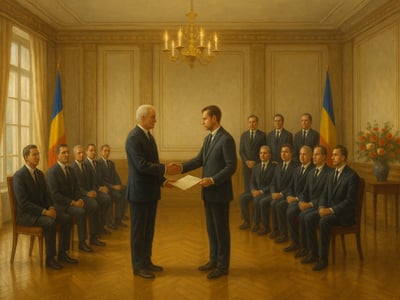
Appointment of Robert Fico's fourth cabinet at the Presidential Palace in Bratislava, 25 October 2023.
On 25 October 2023, at the Presidential Palace in Bratislava, President Zuzana Čaputová appointed Robert Fico as prime minister of Slovakia, formally inaugurating his fourth term as head of government. The ceremony marked the end of several weeks of post-election negotiations that followed Slovakia’s early parliamentary election at the end of September. Although the appointment itself was brief and ceremonial, it represented the constitutional conclusion of a process in which election results had to be translated into a governing majority.
The immediate background was the early parliamentary election held on 30 September 2023. In that vote, Fico’s party, Smer-SD, finished first. In a parliamentary system such as Slovakia’s, finishing first does not by itself guarantee control of government. A cabinet must be able to command support in the National Council of the Slovak Republic, and that usually means coalition bargaining among several parties. The election therefore opened not only a contest over seats, but also a second phase in which party leaders had to determine whether a stable majority could be assembled.
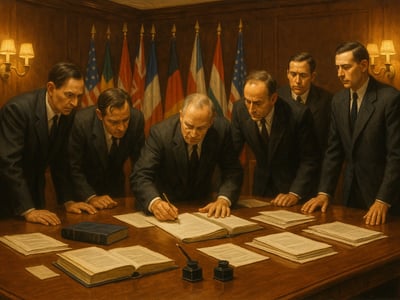
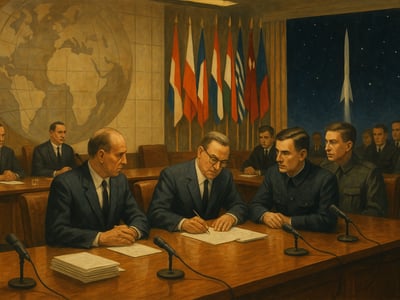
That phase moved quickly. On 11 October 2023, Smer-SD, Hlas-SD, and the Slovak National Party signed a coalition agreement in Bratislava. The agreement established the political basis for a new government by bringing together three parliamentary parties. Coalition agreements in systems like Slovakia’s do more than signal political intent. They help show the president, parliament, and the public that a prospective prime minister has the support needed to form a cabinet that can function beyond the first days after appointment.
The coalition formula also showed the importance of alliances in Slovak politics. Smer-SD had won the strongest position in the election, but it still required partners to move from electoral success to executive authority. Hlas-SD, associated with Peter Pellegrini, became a key partner in making a majority possible, while the Slovak National Party, led by Andrej Danko, was the third pillar of the coalition arrangement. Together, those parties provided the parliamentary base on which the incoming government rested.
President Čaputová’s role came next. Under Slovakia’s constitutional system, the president appoints the prime minister and then the government, but this presidential role operates within the realities of parliamentary arithmetic. On 16 October 2023, Čaputová appointed Fico as prime minister-designate, giving him the formal task of forming a cabinet. That step reflected a practical constitutional principle: the head of state appoints a figure who appears capable of assembling majority support in parliament.
Between 16 and 25 October, attention centered on the composition of the cabinet and the transfer of authority from the caretaker arrangement to a fully appointed government. In parliamentary democracies, this interval can be politically sensitive. Coalition partners must not only agree on governing together but also settle the distribution of ministries and the structure of executive responsibility. If those talks fail, the country can remain in a provisional situation longer than expected. In Slovakia’s case, the coalition negotiations produced a cabinet that the president could appoint within days.
The appointment on 25 October therefore had significance beyond the personal milestone of a fourth premiership for Fico. It marked the formal end of one phase of the 2023 political cycle and the start of another: governing. The Fourth Cabinet of Robert Fico was appointed at the Presidential Palace, and the new administration took office on the basis of the coalition formed by Smer-SD, Hlas-SD, and the Slovak National Party.
Fico’s return also connected the moment to a longer political trajectory. A fourth term is unusual enough to underline his enduring place in Slovak public life. Yet the event was not simply a story about one politician’s persistence. It was also a demonstration of how institutions work when a fragmented election result must be turned into an executive government. The election identified the leading party, coalition negotiations produced a majority formula, the president designated a prime minister to form a cabinet, and the government was then formally appointed.
That sequence is easy to overlook because the final ceremony appears straightforward. In reality, each stage depends on separate actors making separate decisions. Voters determine the composition of parliament. Party leaders decide whether they can cooperate. The president assesses whether a proposed government can plausibly function. Only after those steps are aligned does a cabinet come into being. On 25 October, that process reached its formal conclusion in Bratislava.
Why it still matters
This episode remains useful because it offers a clear example of how coalition politics operates in Slovakia’s constitutional framework. In many parliamentary democracies, elections do not produce a single-party government, so the key political question after voting day becomes whether party leaders can build a workable majority. The events of October 2023 show that the path from election result to government is procedural as much as electoral.
It also illustrates the role of the president in a parliamentary system. Čaputová did not determine the election outcome or negotiate the coalition herself, but her appointment powers were essential in converting the coalition agreement into a lawful government. The office of the president thus serves as a constitutional link between parliamentary politics and executive formation.
More broadly, the appointment of Fico’s fourth cabinet shows how executive authority in Central European democracies often depends on party alliances rather than on one party acting alone. For observers of Slovak politics, the event is a recent case study in how elections, coalition bargaining, and constitutional procedure combine to produce a government. For anyone trying to understand parliamentary systems, it is a reminder that governing majorities are usually built step by step, and that the final appointment ceremony reflects negotiations and decisions already made behind it.
Timeline
- Slovak parliamentary election
- Coalition agreement signed in Bratislava
- Robert Fico named prime minister-designate
- Appointment of Robert Fico as prime minister
What you uncovered
How a Cabinet Takes Shape
You didn't just… complete a puzzle; you traced the final step in how coalition bargaining, presidential procedure, and parliamentary arithmetic produced a new Slovak government.
In Slovakia's parliamentary system, winning the most votes does not by itself create a government. Executive power takes shape through coalition agreements, presidential designation, and the formal appointment of a cabinet that can function within the legislature's balance of parties. Fico's fourth cabinet is a recent example of how political authority in multi-party systems is assembled through procedure as much as through election night results.
Before the cabinet was appointed on 25 October 2023, Smer-SD, Hlas-SD, and the Slovak National Party signed their coalition agreement on 11 October in Bratislava.
FAQ
When did Robert Fico become prime minister for the fourth time?
He was appointed prime minister on 25 October 2023. That marked the start of his fourth term as head of government.
Which parties formed Slovakia’s coalition government in October 2023?
The coalition was formed by Smer-SD, Hlas-SD, and the Slovak National Party. They signed a coalition agreement in Bratislava on 11 October 2023.
Who appointed Robert Fico as prime minister in 2023?
President Zuzana Čaputová appointed him prime minister-designate on 16 October 2023. She then formally appointed the Fourth Cabinet of Robert Fico on 25 October 2023 at the Presidential Palace in Bratislava.
What led to the formation of Fico’s fourth cabinet?
Slovakia held an early parliamentary election on 30 September 2023, and Smer-SD finished first. Coalition negotiations then produced a governing majority with Hlas-SD and the Slovak National Party.