
About this story
On 20 September 1944 Soviet and Czechoslovak forces were still fighting through the Dukla Pass toward northeastern Slovakia, hoping to reach the Slovak National Uprising that had begun on 29 August. The Carpathian-Dukla operation had opened on 8 September. Terrain and German defenses made a fast relief impossible.
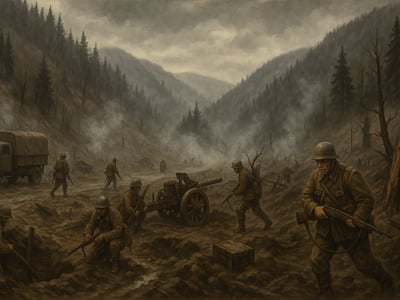
Carpathian-Dukla fighting near the route into northeastern Slovakia, September 1944
On 20 September 1944, fighting in the Dukla Pass sector had become a test of time as much as force. Soviet-led and Czechoslovak troops were trying to push from southeastern Poland across the mountains into northeastern Slovakia, where the route offered one of the most direct approaches toward territory tied to the Slovak National Uprising. Yet by that date, the hoped-for rapid breakthrough had not come. The offensive was still grinding forward through difficult terrain and strong German defenses, while the urgency of events inside Slovakia continued to grow.
An uprising that needed a corridor
The wider context had taken shape only weeks earlier. On 29 August 1944, the Slovak National Uprising began, creating a new military and political problem in the middle of the war. Insurgent forces in central Slovakia needed outside support if they were to hold out against German countermeasures. For Soviet command, the uprising added immediate pressure to operations on the Eastern Front. On 8 September, the Red Army opened the East Carpathian Strategic Offensive, including the Carpathian-Dukla operation, with the aim of breaking through the border region and advancing toward Slovakia.
The route through the Carpathians looked direct on a map, but the conditions on the ground worked against speed. The Dukla Pass sector lay along the corridor from the Krosno area in southeastern Poland toward the Svidník area in northeastern Slovakia. Mountain roads were limited, movement was channelled, and defenders could use elevation and prepared positions to slow an attacker far more effectively than on open ground. In such terrain, every village, ridge, and road junction could impose delays out of proportion to its size.
The attacking force was not Soviet alone. The 1st Czechoslovak Army Corps under Ludvík Svoboda took part alongside Soviet formations, an important detail both militarily and symbolically. The presence of Czechoslovak troops linked the campaign to the future restoration of Czechoslovak state authority and to the effort to reach Slovak territory with forces that could claim a national as well as allied role. Soviet commanders, including Ivan Konev at the front level and Andrei Grechko in the sector, were therefore pursuing an operation that carried both strategic and political weight.
Mountains against a timetable
That combination helps explain why the offensive kept being pressed despite mounting difficulties. The relief objective was urgent: if the front could move fast enough, Soviet and Czechoslovak forces might connect with the uprising before German forces crushed it. But urgency did not remove the realities of mountain warfare. German defenses in the Carpathians had been organized to exploit terrain, and the attackers found themselves forced into costly, slow progress. Mid-September did not bring the kind of breakthrough planners had hoped for.
By 20 September, this contradiction was impossible to miss. The operation was still active, still committed, and still moving in the direction of Slovakia. At the same time, campaign chronologies place this date firmly in the period of heavy fighting before the pass itself was secured in early October. In other words, the offensive had not failed outright, but neither had it achieved the speed on which the relief mission depended. What was being lost was not only men and materiel, but time.
20 September without a breakthrough
That matters because relief operations are judged differently from offensives with broader territorial goals. In a conventional advance, delays may be serious without necessarily undoing the larger plan. In a relief effort, delay can alter the meaning of success itself. If the attacking force reaches the objective too late, it may still take the ground but miss the purpose that gave the operation its urgency. The Dukla fighting in late September 1944 shows this problem clearly. Forces were still advancing, but the timetable that linked the offensive to the uprising was slipping away.
The human decisions inside that problem were difficult. Commanders had to decide whether to continue pressing a punishing sector because it remained the most politically and strategically important route, or whether the costs and delays had already undermined the original objective. There was no easy alternative. Changing the axis of attack in mountainous wartime conditions was not a simple matter, and the uprising itself did not allow for a leisurely recalculation. Every day of delay narrowed the chance that the operation would do what it had been launched to do.
Relief that arrived too late
The geography of the battlefield also shaped memory after the war. Dukla Pass became more than a tactical location. It turned into a symbol of the attempt to reach Slovakia from the east at a decisive moment. That symbolism can sometimes flatten the actual military picture, which was more difficult and more uncertain than later commemorative narratives suggest. On 20 September, no final outcome was yet visible from the front. There was only a hard-fought offensive, severe terrain, and an increasingly urgent clock.
The later course of events gave this moment added significance. Soviet and Czechoslovak forces did eventually secure the pass in early October and continued fighting around the Svidník area. But the Slovak National Uprising was not relieved in time to prevent its military suppression that same month. That does not erase the importance of the operation, but it does define its limits. The crossing into Slovak territory was real; the hope of timely relief proved much harder to achieve.
Why it still matters
The Carpathian-Dukla operation remains important because it shows how military plans can be overtaken by terrain, timing, and the changing pace of events beyond the battlefield. It is often remembered in connection with liberation and resistance, but it is also a case study in the constraints of offensive warfare in mountains. Even with large forces and a clear objective, movement could slow to a crawl when roads, weather, elevation, and prepared defenses all worked in favor of the defenders.
It also illustrates how coalition warfare operated in practice. Soviet command structures and the 1st Czechoslovak Army Corps fought as part of the same campaign, but not without the complications that come whenever military aims carry political meaning as well as operational demands. The presence of Czechoslovak troops mattered to morale, legitimacy, and postwar memory, even though the battlefield itself remained governed by attrition and logistics.
For Slovakia, the Dukla fighting remains closely tied to remembrance of the uprising and of the war's turning point on its territory. Interpretations can differ depending on national tradition, archival emphasis, and later politics. Still, 20 September 1944 offers a clear historical snapshot: by then, the attempt to force the mountain barrier and reach the uprising was still underway, but the central obstacle was no longer only the enemy line. It was the growing gap between an urgent objective and the time required to reach it.
Timeline
- Slovak National Uprising begins
- Carpathian-Dukla operation begins
- Heavy fighting continues in the Dukla Pass sector
- Pass secured in early October
What you uncovered
When Time Became the Obstacle
You didn't just… complete a wartime scene; you traced a moment when the effort to reach Slovakia was being slowed by terrain, defenses, and time itself.
By 20 September, the key problem of the operation was no longer just where to attack, but whether the attack could move fast enough to matter. The campaign shows how relief offensives can fail on timing even before they fail on territory. It also highlights the limits of coalition command in difficult terrain, where shared objectives did not remove the practical burdens of mountain warfare and attrition.
The 1st Czechoslovak Army Corps under Ludvík Svoboda fought alongside Soviet forces in the Carpathian-Dukla operation.
FAQ
What happened in the Dukla Pass sector on 20 September 1944?
On 20 September 1944, fighting was underway in the Dukla Pass sector as part of the Carpathian-Dukla operation. Soviet-led and Czechoslovak forces were trying to break through toward Slovakia, but the advance was still slowed by strong German defenses and difficult mountain terrain.
Why was the Carpathian-Dukla operation launched in September 1944?
It was launched as part of the East Carpathian Strategic Offensive on 8 September 1944. One of its aims was to reach Slovakia from the Dukla Pass route and support the Slovak National Uprising.
How was the Slovak National Uprising connected to the fighting at Dukla Pass?
The Slovak National Uprising had begun on 29 August 1944, creating an urgent need for relief from the east. The Dukla offensive was intended to connect with insurgent forces in central Slovakia.
Which forces were involved in the Dukla offensive?
The operation involved Soviet forces and the 1st Czechoslovak Army Corps under Ludvík Svoboda. The campaign was part of the broader Eastern Front fighting in the Carpathian region.
When was Dukla Pass secured during the 1944 offensive?
Contemporary campaign chronologies place the securing of the pass in early October 1944. On 20 September, the fighting was still ongoing and the breakthrough had not yet been achieved.