
About this story
On 22 September 1811 Michal Miloslav Hodža was born in Rakša, then in Turóc County of the Kingdom of Hungary. He became a Lutheran pastor, writer, and organizer of the Slovak national movement. With Ľudovít Štúr and Jozef Miloslav Hurban he met at Hlboké in 1843 on a literary standard, later taking part in Tatrín and the 1848 demands at Liptovský Mikuláš.
Michal Miloslav Hodža, born in Rakša in Turóc County on 22 September 1811.
On September 22, 1811, Michal Miloslav Hodža was born in Rakša, in Turóc County of the Kingdom of Hungary, a region that is now part of Slovakia. At the time, this was a society shaped by overlapping loyalties, languages, and institutions. Local life unfolded in villages and church communities, while political authority rested in the larger framework of the Habsburg monarchy and the Kingdom of Hungary. Hodža would grow up to work within that complicated world as a Lutheran pastor, writer, and public figure, becoming one of the important participants in the 19th-century Slovak national movement.
A birth in Rakša
His birth itself did not announce any future prominence. What makes it historically significant is the path his life later took. Hodža belonged to a generation for whom language, religion, education, and public organization were closely connected. In the first half of the 19th century, many cultural and political questions in Central Europe were not yet carried by mass political parties or universal suffrage. They were often developed instead through schools, churches, reading circles, publications, and learned associations. Clergymen could play a large role in this process, not only because they were educated, but because they were positioned between local communities and wider intellectual networks.
That setting helps explain Hodža's later importance. He did not act alone, and he is usually remembered alongside figures such as Ľudovít Štúr and Jozef Miloslav Hurban. Together, these men became linked with efforts to give Slovak public life a firmer cultural and linguistic foundation. Their work unfolded in an environment where literary expression, education, and political claims had to navigate the multilingual and hierarchical institutions of the Kingdom of Hungary.
Language as public infrastructure
One of the central questions facing Slovak activists of the period was how to create a shared literary language that could support broader public communication. Without such a standard, writing and publishing remained more fragmented, and it was harder to build a sustained cultural program. This was not just a technical issue of grammar or spelling. A literary standard could help connect scattered readers, writers, clergy, students, and local leaders into something more durable.
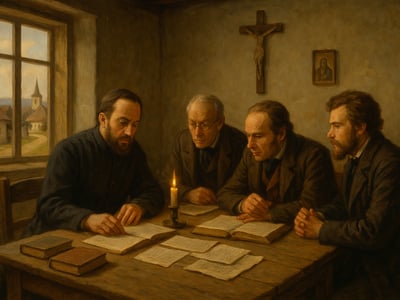
Hodža became part of this turning point through the meeting held on July 11, 1843, at Hlboké. There, Ľudovít Štúr, Jozef Miloslav Hurban, and Michal Miloslav Hodža met in connection with establishing a Slovak literary standard. In later historical memory, this moment became one of the key landmarks in the codification of modern Slovak. The importance of Hodža's presence lies not only in symbolic companionship. It shows that the project rested on cooperation among several public figures who understood language as a practical basis for education, print culture, and collective organization.
Tatrín and 1848
The effort did not end with language. Cultural coordination also mattered. In 1847, Hodža took part in the gathering at Čachtice associated with Tatrín, a cultural institution intended to support Slovak cooperation. Such institutions were important because they provided structure. They linked personal conviction to organized activity, allowing cultural work to continue beyond isolated sermons, poems, or articles. In a period before modern political mobilization had fully developed, associations like Tatrín helped transform shared concerns into collective action.
Then came the revolutionary year 1848, which changed the scale and urgency of political life across Europe. In the Kingdom of Hungary, as elsewhere in the Habsburg lands, reform, representation, and national questions became sharper and more public. On May 10, 1848, Slovak national demands were formulated at Liptovský Mikuláš, and Hodža was among the leading Slovak public figures associated with the movement. Here again, his role reflects the close relationship between cultural and political work. The development of a literary language, the formation of associations, and the articulation of public demands were not separate stories. They formed parts of the same broader effort to define and defend a place for Slovak collective life within existing state structures.
Pastor, writer, organizer
This did not mean that success was straightforward. The institutions of the Kingdom of Hungary were not neutral ground, and minority public movements had to work within systems shaped by hierarchy, limited access, and competing national programs. Much could have remained incomplete. Language reform could have stayed confined to narrow circles. Cultural initiatives could have fragmented. Political demands could have been suppressed or sidelined. Hodža's career is historically meaningful because it illustrates a determined attempt to keep these strands together: church work, writing, organization, and public intervention.
He continued to be remembered as one of the notable representatives of this generation until his death on March 26, 1870, in Těšín, in Austrian Silesia. By then, the world into which he had been born had already changed substantially, but many of the structures that shaped his work—empire, confession, education, and print—remained central to understanding the century.
Why it still matters
Hodža's life offers a useful way to understand how national movements in 19th-century Central Europe were built before modern mass politics. His biography shows that such movements often depended on people who moved between several roles at once: pastor, writer, organizer, and public advocate. Rather than emerging suddenly, political demands were often prepared through years of educational and cultural labor.
His connection with Štúr and Hurban also highlights that language standardization was not an abstract scholarly exercise. It was tied to institution-building. A shared literary form could support publishing, preaching, teaching, and association life. That, in turn, could make broader public coordination possible.
For readers today, Hodža's birth is therefore more than a biographical starting point. It opens a window onto how cultural identity was organized within the Kingdom of Hungary and the Habsburg monarchy, and how local origins in places like Rakša could become linked to wider debates about language, representation, and community. His story helps explain how national life in Central Europe was often assembled through patient work in churches, schools, texts, and associations long before it was expressed through modern state politics.
Timeline
- Birth of Michal Miloslav Hodža
- Hlboké meeting on Slovak literary standard
- Čachtice gathering linked to Tatrín
- Slovak demands at Liptovský Mikuláš
- Death of Hodža in Těšín
What you uncovered
From Parish to Public Life
You didn't just piece together a birth record; you traced the starting point of a life that later linked church work, writing, and public organizing in the Slovak national movement.
Hodža's importance lies less in a single dramatic moment than in the way his roles overlapped. In 19th-century Central Europe, language standardization depended on people who could move between parish life, print culture, and emerging associations. His biography shows how cultural identity was built through institutions and networks before modern mass politics took fuller shape.
On 1843-07-11, Hodža met with Ľudovít Štúr and Jozef Miloslav Hurban at Hlboké in connection with establishing a Slovak literary standard.
FAQ
When was Michal Miloslav Hodža born?
Michal Miloslav Hodža was born on 22 September 1811 in Rakša, then in Turóc County in the Kingdom of Hungary.
Who was Michal Miloslav Hodža?
He was a Lutheran pastor, writer, and participant in the 19th-century Slovak national movement. He later became associated with efforts to define Slovak literary language and public political demands.
How was Hodža connected to Ľudovít Štúr and Jozef Miloslav Hurban?
Hodža met Ľudovít Štúr and Jozef Miloslav Hurban at Hlboké on 11 July 1843 in connection with establishing a Slovak literary standard. This meeting linked him to the language codification effort.
What role did Hodža play in the Slovak national movement?
He took part in the Čachtice gathering in 1847 associated with Tatrín and was among the leading Slovak public figures when national demands were formulated at Liptovský Mikuláš on 10 May 1848.