
About this story
On 1 October 1931 regular work began at Slovenská slepecká tlač in Levoča, producing books, textbooks, and periodicals for blind readers. The change was from occasional texts to a standing press with trained staff and specialized equipment. Later steps in the same institutional line include a Braille library opened in Báhoň in 1955 and a purpose-built printing and library building handed over in Levoča in 1976.
Slovenská slepecká tlač in Levoča began regular operation on 1 October 1931.
On 1 October 1931, regular operation began at Slovenská slepecká tlač in Levoča, in what is now Slovakia. The moment did not announce a political turning point or a spectacular invention. Its importance lay elsewhere: it marked the start of sustained, organized publishing for blind readers in a place where access to reading materials had too often depended on limited or occasional efforts.
Reading as access, not a luxury
For blind readers, and especially for students, reading was not simply a matter of personal interest. It was tied to literacy, schooling, professional preparation, and participation in cultural life. A textbook that arrived late, a periodical that appeared irregularly, or a book that existed only in a hard-to-find adapted version could narrow the range of what a person could study and follow. In that sense, access to text was also access to time, continuity, and independence.
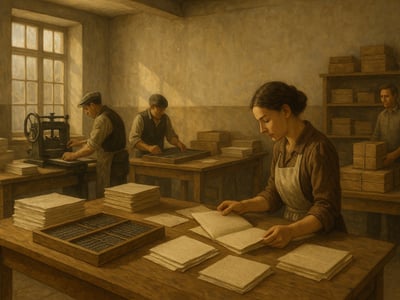
That is what made a regular printing operation significant. Slovenská slepecká tlač was established to produce books, textbooks, and periodicals for blind readers as part of an ongoing institutional process. Instead of relying on sporadic publication, the Levoča operation created a framework in which adapted reading matter could be planned, prepared, and issued with greater reliability.
This shift from occasional provision to routine production may sound administrative, but it carried real consequences. Publishing for blind readers required more than goodwill. It depended on trained staff, specialized equipment, editorial organization, and a commitment to continuity. Each of those elements involved practical effort and expense. To begin regular operations was to accept that accessibility was not an afterthought but a task that had to be built into daily institutional work.
From occasional books to a press
Levoča became an important center for that work. The town’s role in services for blind readers was not accidental. It formed part of a broader local institutional base connected with education and support for people with visual impairment. In such a setting, a printing house devoted to accessible materials could do more than produce isolated titles. It could support a system in which reading, study, and information were expected to be available over time.
The interwar years in Czechoslovakia brought many pressures to public and educational institutions, and specialized publishing was unlikely to be the largest or most visible field. Yet that is part of why the beginning of regular operation matters. It shows that accessible publishing was being treated as a continuing responsibility rather than an occasional charitable gesture. Textbooks had to be prepared for classroom use. Books had to exist for readers beyond the classroom. Periodicals had to appear often enough to keep readers connected to current writing and public life.
Levoča and a regular rhythm
The mention of periodicals is especially revealing. A book can preserve knowledge, but a periodical creates rhythm. It gives readers repeated access to news, discussion, literature, or community information. For blind readers, regular publication meant not only possessing reading materials but also participating in a shared tempo of reading. That changed the meaning of access: it was no longer just about whether a text existed, but whether readers could expect material to keep coming.
There is also an institutional lesson in the date itself. A launch can be symbolic, but regular operation is operational. It suggests that preparatory work had moved into a lasting routine. Equipment had to function, production had to be scheduled, and the institution had to prove that it could continue. The achievement was therefore not only the founding of an organization, but the start of dependable output.
A line that led toward a library
Because the available record emphasizes the institution and its mission more than individual personalities, the story is less about a single celebrated founder than about a collective commitment. That too is fitting. Accessibility infrastructure often depends on systems that are easy to overlook precisely because they are designed to become normal and dependable. When they work well, they fade into the background of everyday life. But for the people who rely on them, their presence is decisive.
The later history of the institution helps explain the weight of this beginning. Slovenská slepecká tlač did not remain only a short-lived experiment. Its development eventually led to the Slovak Library for the Blind of Matej Hrebenda in Levoča. That continuity shows that the work begun in 1931 became part of a longer institutional tradition rather than a temporary response to immediate need.
Why it still matters
The start of regular operations at Slovenská slepecká tlač offers an early example of accessible publishing becoming part of educational and cultural infrastructure. It reminds us that equal access to reading is not achieved only through ideas or legal principles. It also depends on institutions that can produce, organize, and distribute materials in forms readers can use.
The event also highlights a broader truth about accessibility history: progress often comes through routine capacity. A printing house, a library, a catalog, a staff trained to prepare adapted texts—these may seem less dramatic than inventions or public campaigns, but they are what make access durable. In Levoča, the move to regularized production meant that blind readers could be served not occasionally, but systematically.
Its legacy endures in the institutional line that leads to the Slovak Library for the Blind of Matej Hrebenda. That survival across changing times suggests that accessibility services can outlast the circumstances of their founding when they are embedded in stable public and cultural structures.
What began on 1 October 1931 was therefore more than the opening of a specialized printing operation. It was the establishment of a reliable mechanism for reading access in Slovakia: one that linked literacy, education, and cultural participation for blind readers to something concrete and repeatable. The significance of the date lies in that practical achievement. A service that could have remained occasional became regular, and regularity itself changed what access could mean.
Timeline
- Regular operation begins at Slovenská slepecká tlač in Levoča
- A Braille library opens in Báhoň
- A purpose-built printing and library building opens in Levoča
What you uncovered
When Access Became Routine
You didn't just… complete a puzzle; you traced the moment accessible publishing in Levoča began to operate as a steady public service for blind readers.
What changed here was not only the existence of adapted texts, but the decision to produce them continuously. That kind of routine matters because access becomes more dependable when it is built into staffing, equipment, and regular output rather than left to occasional goodwill. The later continuity of the institution shows how accessibility often lasts when it is treated as infrastructure, not exception.
The institution in Levoča later developed into the Slovak Library for the Blind of Matej Hrebenda.
FAQ
What happened at Slovenská slepecká tlač on 1 October 1931?
Regular operation began at Slovenská slepecká tlač in Levoča on 1 October 1931. The institution was set up to produce accessible reading materials for blind readers on an ongoing basis.
Where was Slovenská slepecká tlač located?
Its documented place of operation was Levoča, a town in eastern Slovakia. The event took place there as part of a local institutional base for accessible publishing.
What did Slovenská slepecká tlač print for blind readers?
It produced textbooks, books, and periodicals prepared for blind readers. The aim was organized, continuing publication rather than occasional output.
How is Slovenská slepecká tlač connected to the Slovak Library for the Blind of Matej Hrebenda?
The institution later developed into the Slovak Library for the Blind of Matej Hrebenda in Levoča. This shows that the work in 1931 became part of a lasting institutional history.