
About this story
1735 authorization from Vienna concerning mining instruction in Banská Štiavnica.
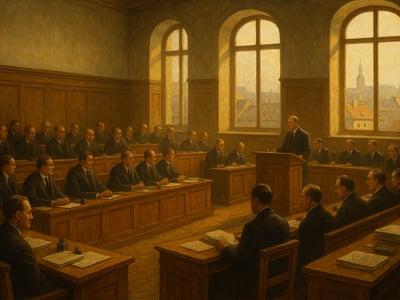
On 22 June 1735, the Court Chamber in Vienna issued an authorization concerning the creation of a mining school in Banská Štiavnica, one of the leading mining towns of the Kingdom of Hungary within the Habsburg Monarchy. The decision did not emerge from abstract interest in education alone. It reflected the practical demands of a mining district where extraction, drainage, surveying, and supervision all depended on technical skill that could no longer be left entirely to informal custom.
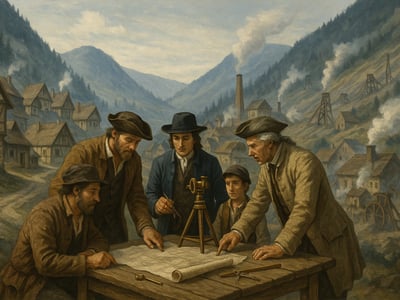
By the early eighteenth century, Banská Štiavnica had long been known for precious-metal mining, especially silver and gold. Its importance rested not only on what lay underground but also on the systems required to reach and manage those resources. Mines needed accurate measurement, dependable mapping, and oversight that could connect local work to wider administrative and financial goals. A mistake in surveying could affect ownership, taxation, drainage works, or the direction of excavation. A shortage of trained personnel could weaken both output and control.
In that setting, the decision taken in Vienna was a sign of how closely mining and government administration had become linked. The Court Chamber was the central financial and administrative authority involved in mining oversight within the monarchy. When it authorized a school initiative for Banská Štiavnica, it was recognizing that mining efficiency and state interest required more than experience passed from one worker to another. Practical knowledge remained essential, but it increasingly needed to be reinforced by organized instruction.
That shift mattered because mining was a field where local practice and formal knowledge constantly met. A miner could learn much underground, yet the larger operation also depended on people who could calculate, record, draw, measure, and supervise. Surveying was especially important in a district where the physical layout of mines, galleries, shafts, and surrounding land had direct legal and economic consequences. Technical education in this sense was not separate from production. It was part of the machinery that allowed production to continue.
The 1735 authorization therefore marked an early institutional step. It suggested that training in mining-related subjects should be supported in a more regular and supervised way. Accounts of the school's early phase often connect Samuel Mikovíni to this development. Mikovíni is well known for work in surveying, cartography, and engineering, and his name appears frequently in later discussions of early technical instruction in Banská Štiavnica. At the same time, the precise scope of his role in the school's earliest phase can vary across sources, so it is safer to say that he is closely associated with the beginning of organized instruction rather than to assign him a larger role than the record clearly supports.
Even with official approval, the outcome was not guaranteed. Administrative authorization was only the beginning. A school initiative still needed teachers, students, continuity, and acceptance within the local mining environment. It had to fit the needs of the district rather than remain only a formal order issued from the capital. In many parts of early modern Europe, decrees could remain limited in effect if they were not backed by personnel, funding, and habits of use. The significance of the 1735 decision lies partly in the fact that it pointed toward durable institutional development instead of stopping at paperwork.
Banská Štiavnica was a fitting place for such an experiment in organized technical teaching. It was not a peripheral settlement with occasional extraction, but a major mining center with a long-established economic role. That meant the town already stood at the meeting point of local labor, regional administration, and imperial interest. The problems officials hoped to address were concrete: how to maintain competent oversight, how to improve the reliability of measurement, and how to support a workforce able to handle increasingly demanding technical tasks.
This is also why the event should be understood as part of a broader Central European pattern. Across the Habsburg lands, resource extraction required systems of management as well as labor. States were learning that valuable industries could not depend indefinitely on inherited practice alone. They needed institutions that could transmit skills more consistently. In that sense, the authorization for Banská Štiavnica belongs to a larger history in which technical education grew from administrative and economic necessity.
Why it still matters
The 1735 authorization still matters because it shows how technical education often begins. It does not necessarily start in lecture halls as a purely theoretical project. More often, it begins when governments, industries, and communities face recurring practical problems that demand reliable training. In Banská Štiavnica, the pressures came from mining itself: the need for accurate surveying, competent supervision, and a more predictable way to prepare people for specialized work.
The event also helps explain the historical place of Banská Štiavnica in the wider story of engineering and mining education in Central Europe. Later institutions did not appear from nowhere. They were built on earlier efforts to connect practice with organized teaching. The 1735 decision is important not because it instantly solved every local problem, but because it represents a documented administrative commitment to that connection.
Finally, the story offers a useful reminder about the relationship between state power and knowledge. The Court Chamber's involvement shows that education in strategic industries was tied to governance, finance, and oversight. Training people was not only a cultural investment; it was also a way to strengthen the operation of a vital economic sector. Seen from that perspective, the authorization issued in Vienna on 22 June 1735 was a small administrative act with a long institutional afterlife, linking one mining town to a much larger history of technical learning.
Timeline
- Mining administration development in the Habsburg lands
- Banská Štiavnica as a mining center
- Samuel Mikovíni's surveying and engineering work
- Formal technical education in Central Europe
- State administration and resource extraction
- Court Chamber authorization for a mining school in Banská Štiavnica
What you uncovered
When Work Becomes School
You didn't just… complete a puzzle; you traced the moment when mining know-how began to move from the worksite into more formal instruction.
This decision matters because it shows that technical education often grows out of administration as much as out of scholarship. In Banská Štiavnica, the pressures of surveying, measurement, and mine oversight made training a practical necessity for the state, not simply an intellectual project. That helps explain why early technical schools were closely tied to industries where errors had financial and operational consequences.
The 22 June 1735 measure was issued by the Court Chamber in Vienna, the central administrative body involved in mining oversight in the Habsburg Monarchy.
FAQ
What happened on 22 June 1735 in Vienna?
On 22 June 1735, the Court Chamber in Vienna issued an authorization concerning a mining school for Banská Štiavnica. The decision supported organized instruction linked to mining practice and technical subjects.
Was 22 June 1735 the founding date of the school?
It was the date of an official authorization, not necessarily the date when teaching began in full. Sources may describe the later school history in slightly different ways, so the distinction matters.
Why did Habsburg authorities support mining instruction there?
Banská Štiavnica was an important mining town, and mining operations depended on accurate surveying, measurement, and technical oversight. Organized instruction was meant to strengthen those skills within the district.
How was Samuel Mikovíni connected to the early school?
Samuel Mikovíni is often linked in later accounts to the school's early instructional phase. The exact scope of his role should be confirmed in source-specific accounts.
Why is Banská Štiavnica important in technical education history?
The 1735 authorization shows an early link between state administration and organized technical training in a mining center. It is one reason Banská Štiavnica appears in the broader history of mining, engineering, and professional education in Central Europe.