
About this story
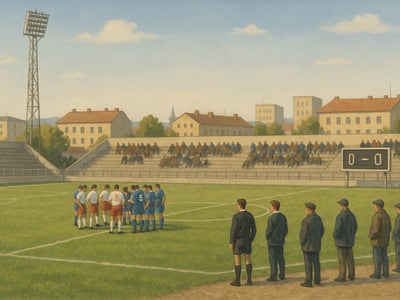
On 14 August 1993 the first Slovak Superliga season opened as independent Slovakia’s top football competition, only months after Czechoslovakia dissolved on 1 January 1993. Under the Slovak Football Association, a twelve-club national league turned clubs once tied to a federal system into the backbone of a new domestic championship.
Opening of the 1993–94 Slovak Superliga in independent Slovakia
On 14 August 1993, the 1993–94 Slovak Superliga opened as the top domestic football competition of the newly independent Slovak Republic. The first round arrived only a little more than seven months after 1 January 1993, the date on which Czechoslovakia dissolved and Slovakia emerged as a separate state. What looked, on the surface, like the routine start of a football season was also an institutional test: a new country needed a new top division, and that meant building a competition structure quickly enough for clubs, officials, and supporters to recognize it as the national championship.
Football as an institutional test after independence
Before 1993, leading Slovak clubs had competed within the shared Czechoslovak league system. That framework had linked teams across the federation and provided the familiar hierarchy through which clubs advanced, were relegated, and measured themselves. Once the state dissolved, the sports structures associated with it also had to be separated or replaced. Football was one of the most visible areas where that reorganization had to happen in practical terms. A league calendar could not be postponed indefinitely, and clubs needed clarity about where they would play, against whom, and under which governing authority.
The new competition was conducted under the Slovak Football Association in independent Slovakia. For administrators, this required more than simply renaming an existing tournament. A top division had to be defined, participating clubs confirmed, fixtures organized, and the season placed on a workable schedule. These were ordinary tasks in one sense, but in 1993 they carried added weight. If the new league had stumbled at the start, it could have undermined confidence in the domestic football structure at a moment when the wider public institutions of the state were also still taking shape.
From the Czechoslovak system to Slovak governance
The 1993–94 Slovak Superliga season included 12 clubs. Among them were ŠK Slovan Bratislava, FK Inter Bratislava, DAC Dunajská Streda, 1. FC Košice, Spartak Trnava, and MŠK Žilina. Their presence gave the new competition immediate recognizability. These were clubs with established identities, local rivalries, and existing supporter bases. That mattered because the success of a league is not created only in meeting rooms; it also depends on whether communities accept the competition as meaningful.
The geography of the league helped underline that this was intended to be a national championship rather than a temporary administrative arrangement. Clubs from Bratislava, Košice, Trnava, Dunajská Streda, and Žilina represented different parts of the country and brought distinct football traditions into the same competition. In that sense, the opening of the season did not simply mark the start of matches. It marked the transfer of football continuity from a federal setting into a Slovak national one.
Twelve clubs and a national championship map
This transition also required a change in perspective for clubs themselves. Teams that had previously situated their ambitions within a joint Czechoslovak system now had to adjust to a Slovak-only top tier. The competitive map was different, the institutional references were different, and the league now carried a new symbolic role. It was no longer only a route to sporting success inside an established federation; it was also part of how independent Slovakia organized one of its most visible public pastimes.
In that broader context, football administrators had to make choices that were both technical and consequential. A 12-club format offered a manageable starting point for a national top division. It balanced the need for a credible elite competition with the practical realities of a newly reorganized system. The league’s launch on schedule in August suggested that, despite the speed of the transition, the necessary groundwork had been completed well enough for the season to proceed in an orderly way.
Legitimacy built through a working season
The event also belongs to a larger pattern seen whenever political borders change and shared institutions are separated. Sports competitions may seem secondary compared with constitutions, currencies, or diplomatic recognition, but they require their own infrastructure and legitimacy. Fixtures, registration, governance, records, and qualification pathways all have to be rebuilt or reassigned. The start of the Slovak Superliga in August 1993 offers a clear example of that process in a form that was immediately visible to the public.
Jozef Vengloš is often associated with this early era of Slovak football institutions, representing the broader effort to give the country a recognizable sporting framework after independence. Even when the work of institution-building happens behind the scenes, public competitions such as a top football league become one of its clearest expressions.
Why it still matters
The opening of the first Slovak Superliga season still matters because it shows how national sports systems are reorganized after state separation. The league was not an abstract declaration but a working structure: clubs entered it, matches were scheduled, and a new top tier became real through regular competition. That practical success helped establish continuity for football in Slovakia at a moment of wider political and administrative change.
It also marks the beginning of a stable top-level competition under Slovak football institutions. For clubs, supporters, and historians, the 1993–94 season serves as a reference point for records, titles, and league continuity in independent Slovakia. When later achievements are discussed, they are measured against a competition whose starting line can be dated precisely to August 1993.
More broadly, the league’s launch reminds us that statehood reshapes everyday structures as well as formal politics. Football calendars, governing bodies, and domestic championships may seem routine once established, but they have to be built. The first season of the Slovak Superliga stands as one of the clearest sports examples of how independent Slovakia began organizing its own national life.
Timeline
- Czechoslovakia dissolves; Slovakia becomes independent
- 1993–94 Slovak Superliga season begins
- Twelve-club national top division opens under the Slovak Football Association
What you uncovered
Building a League from Scratch
You didn't just… finish a football puzzle; you traced one of the first practical steps in organizing top-level sport in independent Slovakia.
A new league is not only a set of fixtures on a calendar, but a sign that rules, oversight, and competition can function under a new state structure. The 1993–94 Slovak Superliga shows how quickly sport has to adapt when political borders change, because clubs still need schedules, governing authority, and a shared framework that people recognize as legitimate. That kind of continuity matters long after the opening round, since it shapes how records, rivalries, and club histories are carried forward.
The first Slovak Superliga season in 1993–94 was played by 12 clubs under the Slovak Football Association.
FAQ
What happened on 14 August 1993 in Slovak football?
On 14 August 1993, the 1993–94 Slovak Superliga began as Slovakia's top domestic football competition. It was the first season of the independent national league after the dissolution of Czechoslovakia.
What was the 1993–94 Slovak Superliga?
It was the top football division in the newly independent Slovak Republic. The season was conducted under the Slovak Football Association.
Why did Slovakia create a separate top league in 1993?
After Czechoslovakia dissolved on 1 January 1993, Slovakia organized its own domestic football structure. The new league replaced the former shared federal system at the top level.
How many clubs played in the first Slovak Superliga season?
The 1993–94 Slovak Superliga included 12 clubs. It brought together teams from across Slovakia for the opening national season.